I'M READING ABOUT HELEN KELLER AGAIN
Not sure why, but she has always been one of my fascinations. Actually, I find Anne Sullivan Macy and the relationship between the two women the main fascination. I find it extraordinary how Anne Sullivan, a young women barely out of her teens, was able to intuit a pedagogical method that most teachers would probably take a lifetime to put together.
A decade or so after her initial breakthroughs with Helen, Annie sent her insights on the matter to Alexander Graham Bell. She is specifically speaking of imparting language skills here, but I think her ideas are applicable on many other levels even beyond the classroom.
"Thank heaven, I didn't have to follow a curriculum when I began teaching Helen. I am convinced she wouldn't have learned language as easily as she did. It seems to me, it is made as difficlut as possible for a child to learn anything.
Helen learned language almost unconsciously. [In schools today] it is made 'a lesson.' The child sits indoors, and for an hour the teacher endeavors more or less skilfully to engrave words upon his brain.
As I look back, it seems as if Helen were always on the jump when I was teaching her. We were generally in the open air doing something. Words were learned as they were needed. She rarely forgot a word that was given her when the action called it forth, and she learned a phrase or even a sentence as readily as a single word when it was needed to describe an action.
Children learn language more quickly when they are free to move about objects that interest them. They absorb words and knowledge simultaneously. In the classroom, they cease to be actors in the drama. They sit and watch the teacher, which does not excite their curiosity particularly. Passivity does not stimulate interest or mental energy. The child learns eagerly what he wants to know, and indifferently what you want him to know.
...Young children need more out-of-door lessons - lessons about living things - trees and flowers and animals - things they love and are curious about. The number of subjects taught is not so important as that children should learn language for the joy of it. The miracle of education is achieved when this happens.
My sister teaches on a university level and frequently shrugs, "You can lead a man to a university, but you can't make him think." We experience the same challenge with our Act One students. We offer them a wide panoply of classes, but unless a student can see how a particular class might serve him or her "right now", they don't really get engaged. Too often, I find myself looking into glazed expressions while I plead, "Please trust us, this is very crucial stuff." Considering Anne Sullivan's words, I think the problem is that information is only "crucial" when someone is searching for it, as the resolution to a personal problem. You can't force that "problem mode" on students.
Beyond the classroom, though, how do people learn anything? I mean beyond the sheer memorization of facts here. How do people internalize something and make it part of their belief system/presuppositions? It's because they are searching, aware of a need and a void.
This is what I find in teaching RCIA, anyway. You have to let the students tell you what they want to learn, to some extent. You lay out a lesson, and then try and guage which part of it tips off an unanswered question inside of them. This invariably means you don't cover your whole curriculum, but the mustard seed they end up getting will have saving power.
Thursday, September 09, 2004


Wednesday, September 08, 2004
TWO OF THE COOLEST THINGS THE CHURCH DOES IN LOS ANGELES
Reel Spirituality, a creative encounter between the church and Hollywood sponsored by Fuller Theological Seminary invites you to participate in its 2004 conference Friday, October 22 at the Director’s Guild of America in Los Angeles!
Music to our Eyes: Music, Film, and Theology in Dialogue, will bring together film professionals, thinkers, and the clergy to focus on the role that music plays in both the creation and experience of film. Reel Spirituality’s Barry Taylor and Rob Johnston will host the conference.
Registration is now available at www.reelspirituality.org or by calling Fuller’s Brehm Center for Worship, Theology & the Arts at 626 304-3789! Space is limited so please register early if you wish to attend.
Theological issues surrounding the following phenomena will be discussed: how music shapes culture, how meaning is made through music, the collaborative role of film and music, and the return of the musical.
For more details and the latest information, check out www.reelspirituality.org.
Here are just a few speakers/special guests currently scheduled:
Klaus Badelt: Composer, Pirates of the Caribbean (2003), Gladiator (2000), The Thin Red Line (1999)
Marq Roswell: Music Supervisor, Collateral Damage (2002), Sweet November (2001), and The Hurricane (1999)
Graham Ward: Professor of Contextual Theology, U. of Manchester, author of True Religion & Cities of God
Brian McLaren: Founding pastor of Cedar Ridge Community Church, fellow with Emergent, author of The Church on the Other Side: Doing Ministry in the Postmodern Matrix, The Story We Find Ourselves In
Travis Reed: President, Highway Video
Craig Detweiler: Associate Professor of Mass Communications at Biola University, Screenwriter, Extreme Days (2001)
==================================================================================================
The end of the Reel Spirituality Conference will inaugurate the 10th Annual City of Angels Film Festival, also at the Director’s Guild starting October 22 thru the 24th.
Sponsored by Reel Spirituality, Family Theater Productions, InterVarsity, Water’s Edge Communications, Act One, and 24 other organizations, this year’s fest will focus on “Reel Myths”—those films that illuminate the larger myths and stories that shape our spiritual understanding and the human condition.
Films to be screened at CAFF 2004 will include: La Belle et la Bete, Yojimbo, Monty Python and the Holy Grail, Chinatown, Road Warrior, The Lord of the Rings: The Fellowship of the Ring (extended version), The Wizard of Oz, Black Orpheus, and the West Coast Premier of Norman Stone’s Man Dancin’.
Film festival registration will be available at www.cityofangelsfilmfest.org in mid-September. Updated information will also be available at www.cityofangelsfilmfest.org or by calling 626-304-3775.
Reel Spirituality, a creative encounter between the church and Hollywood sponsored by Fuller Theological Seminary invites you to participate in its 2004 conference Friday, October 22 at the Director’s Guild of America in Los Angeles!
Music to our Eyes: Music, Film, and Theology in Dialogue, will bring together film professionals, thinkers, and the clergy to focus on the role that music plays in both the creation and experience of film. Reel Spirituality’s Barry Taylor and Rob Johnston will host the conference.
Registration is now available at www.reelspirituality.org or by calling Fuller’s Brehm Center for Worship, Theology & the Arts at 626 304-3789! Space is limited so please register early if you wish to attend.
Theological issues surrounding the following phenomena will be discussed: how music shapes culture, how meaning is made through music, the collaborative role of film and music, and the return of the musical.
For more details and the latest information, check out www.reelspirituality.org.
Here are just a few speakers/special guests currently scheduled:
Klaus Badelt: Composer, Pirates of the Caribbean (2003), Gladiator (2000), The Thin Red Line (1999)
Marq Roswell: Music Supervisor, Collateral Damage (2002), Sweet November (2001), and The Hurricane (1999)
Graham Ward: Professor of Contextual Theology, U. of Manchester, author of True Religion & Cities of God
Brian McLaren: Founding pastor of Cedar Ridge Community Church, fellow with Emergent, author of The Church on the Other Side: Doing Ministry in the Postmodern Matrix, The Story We Find Ourselves In
Travis Reed: President, Highway Video
Craig Detweiler: Associate Professor of Mass Communications at Biola University, Screenwriter, Extreme Days (2001)
==================================================================================================
The end of the Reel Spirituality Conference will inaugurate the 10th Annual City of Angels Film Festival, also at the Director’s Guild starting October 22 thru the 24th.
Sponsored by Reel Spirituality, Family Theater Productions, InterVarsity, Water’s Edge Communications, Act One, and 24 other organizations, this year’s fest will focus on “Reel Myths”—those films that illuminate the larger myths and stories that shape our spiritual understanding and the human condition.
Films to be screened at CAFF 2004 will include: La Belle et la Bete, Yojimbo, Monty Python and the Holy Grail, Chinatown, Road Warrior, The Lord of the Rings: The Fellowship of the Ring (extended version), The Wizard of Oz, Black Orpheus, and the West Coast Premier of Norman Stone’s Man Dancin’.
Film festival registration will be available at www.cityofangelsfilmfest.org in mid-September. Updated information will also be available at www.cityofangelsfilmfest.org or by calling 626-304-3775.
Tuesday, September 07, 2004
UPDATED LIST OF BARB'S TRAVELS
So many people contacted me for additional talks after I posted the shorter list below, that I thought to post the full list as of this moment of upcoming speeches. Email me if you want to come to any of these, or if you'd like to try and set up another when I am near your place.
October 14 - Legatus Chapter meeting, Naples, Fl
November 6 - University of Dallas
- BOMA Nat'l Convention, Dallas, TX
November 18-20 - Notre Dame Ctr. for Ethics and Culture, South Bend, IN
- Notre Dame, either the English or Philosophy Department
November 26-30 - Catholic Unversity of Milan, You Know Where
November 31-Dec 1 - Santa Croce University, Rome (pending)
December 5 - G K Chesterton Society, Oxford University (pending...and sooooo cool!)
February 12 - Kids Screen Summit, NYC (no talk...just there to learn)
February 16 - Civitas Dei, Indianapolis, IN
- Legatus Chapter meeting, Indianapolis, IN
April 26 - Legatus, New Orleans
- some school, New Orleans, LA
April 27 - Legatus, Baton Rouge, LA
May 17 - Legatus, San Antonio, TX
May 18 - Legatus, Houston, TX
I'll update again as more come in. Is anybody else tired?
So many people contacted me for additional talks after I posted the shorter list below, that I thought to post the full list as of this moment of upcoming speeches. Email me if you want to come to any of these, or if you'd like to try and set up another when I am near your place.
October 14 - Legatus Chapter meeting, Naples, Fl
November 6 - University of Dallas
- BOMA Nat'l Convention, Dallas, TX
November 18-20 - Notre Dame Ctr. for Ethics and Culture, South Bend, IN
- Notre Dame, either the English or Philosophy Department
November 26-30 - Catholic Unversity of Milan, You Know Where
November 31-Dec 1 - Santa Croce University, Rome (pending)
December 5 - G K Chesterton Society, Oxford University (pending...and sooooo cool!)
February 12 - Kids Screen Summit, NYC (no talk...just there to learn)
February 16 - Civitas Dei, Indianapolis, IN
- Legatus Chapter meeting, Indianapolis, IN
April 26 - Legatus, New Orleans
- some school, New Orleans, LA
April 27 - Legatus, Baton Rouge, LA
May 17 - Legatus, San Antonio, TX
May 18 - Legatus, Houston, TX
I'll update again as more come in. Is anybody else tired?
Monday, September 06, 2004
EMILY MONDAY
607
Of nearness to her sundered Things
The Soul has special times --
When Dimness -- looks the Oddity --
Distinctness -- easy -- seems --
The Shapes we buried, dwell about,
Familiar, in the Rooms --
Untarnished by the Sepulchre,
The Mouldering Playmate comes --
In just the Jacket that he wore --
Long buttoned in the Mold
Since we -- old mornings, Children -- played --
Divided -- by a world --
The Grave yields back her Robberies --
The Years, our pilfered Things --
Bright Knots of Apparitions
Salute us, with their wings --
As we -- it were -- that perished --
Themself -- had just remained till we rejoin them --
And 'twas they, and not ourself
That mourned.
607
Of nearness to her sundered Things
The Soul has special times --
When Dimness -- looks the Oddity --
Distinctness -- easy -- seems --
The Shapes we buried, dwell about,
Familiar, in the Rooms --
Untarnished by the Sepulchre,
The Mouldering Playmate comes --
In just the Jacket that he wore --
Long buttoned in the Mold
Since we -- old mornings, Children -- played --
Divided -- by a world --
The Grave yields back her Robberies --
The Years, our pilfered Things --
Bright Knots of Apparitions
Salute us, with their wings --
As we -- it were -- that perished --
Themself -- had just remained till we rejoin them --
And 'twas they, and not ourself
That mourned.
THIS LAND IS MAO'S LAND
Undeniably lush and beautiful, the 2002 Chinese film/Miramax release Xing Xong/Hero is also the most stylish piece of insidious propaganda since Triumph of the Will. Like, Leni Reifenstahl's masterpiece, which was intended primarily to whip up the German people, I think Hero is much more aimed at propagandizing Chinese people than us Westerners. Chilling, that.
The overt message of Hero is that, sometimes, a leader has to kill millions of people to mold a nation into one cohesive body. The "heroic" action in the film, comes down to the king killing a good man, for a greater good. It's hugely telling that the Weinstein's at Miramax green-lit this project for theatrical release in the States. Did they do it as a warning to America about the marshalling of high-level, murderous propaganda by Red China? Or was it something else? Hmmmmmm.....
I have been amazed to see the positive treatment that the film is getting from some prominent Christian reviewers. My guess is, they are being so distracted by the lush visuals in this piece, that they 'can not see past the yellow/red forest for the themes.' But people need to look again. The message here is profoundly anti-Christian. It is a clear vindication of the excesses of Mao style totalitarianism, and an insidious resetting of this governing style into an archtypal Chinese myth about the Qin dynasty. The idea worth killing for in Hero is not justice, or truth, or life, liberty and the pursuit of happiness, but "Our land."
This elevation of a material thing over a spiritual ideal, is absolutely Marxist, although not historically Chinese. Hopefully, seventy years of communism will prove to be a short unconvincing span in the minds and hearts of the Chinese people.
Hero is fascinating on every level but character and story, which highlights its first problem as a cinematic experience for American audiences. Its main appeal lies in its aspect as almost pure "cinema of attractions." Or, as my friend Sean put it, 'Lookee what we can do with fans and fabric!"
As with many of the Asian martial arts films, so much of the point here is to stage fight sequences in yet another more affecting way. To this extent, Hero looks a lot like Crouching Tiger, Hidden Dragon (which also left most of us Westerners scratching our heads. Somebody here in Hollywood christened the project, "Slouching audience, Hidden Screenplay. Which monniker stuck.) Also, like CT,HD, this film ends with a ritualistic suicide that is played as morally self-sacrificing. I see problems ahead for East-West relations based on this completely divergent sensibility.
As beautiful as the cinematography and choreography are in Hero, the special effects are still not as smooth as in Hollywood films. The moments of characters flying in Peter Pan, for example, were executed with much more skill that the jerky artificial flying moments in this film. I also didn't think the fight sequences were as good as they should have been. One of the male leads, Jet Li, is supposed to be the greatest martial artist alive, but his talents are unexploited here.
The film was interesting to me as a filmmaker because it platforms stunning visuals, but not visual imagery, in the lyrical sense that highlights the greatest Western cinema. It reminded me of something my sister, Cynthia, said to me many years ago, which may or not be related, but which I kept thinking on while screening Hero. Cynthia spent several years researching the intellectual heritage of China. She came down to a shrug, finally, which she summarized as, "They have no systematic philosophy." In other words, dialogue between East and West will be very difficult to nearly impossible. (Incidentally, this has become my main struggle in my studies at Fuller Evangelical Seminary. The - mystifying to me - perception is that philosophy is somehow unBiblical...but that's a post for another day.)
I did think it was interesting how most of the emotion in Hero comes not from the political/patriotic struggle, as much as the very human, universal desire of one man to be united to one woman. I sat there marveling, the echos of the same-sex "marriage" debate going through my head. "No, we're not against sanctioning gay unions because we are Christians. It's a human thing."
There are many other differences between China and the West that are manifest in this project. Many values that are so divergent as to be mystifying: the significance of colors, the meaning of caligraphy, the sense of martial arts as "a dance with high stakes, the presence of "hoards" of faceless humans, the glorification of human pride, the parameters/role of the master-student relationship, etc.
I recommend this film as a unique platform to study these differences, as a warning about the new shape of Chinese propaganda, and also to just see the lovely colors and visuals here. For most non-filmmakers, the colors and choreography will get old after about an hour, however, and because of the flawed characterizations (from a Hollywood standpoint), there isn't any real suspense to hang in there for beyond the look of the thing.
So, it's not a pass. But I really don't like this film.
Undeniably lush and beautiful, the 2002 Chinese film/Miramax release Xing Xong/Hero is also the most stylish piece of insidious propaganda since Triumph of the Will. Like, Leni Reifenstahl's masterpiece, which was intended primarily to whip up the German people, I think Hero is much more aimed at propagandizing Chinese people than us Westerners. Chilling, that.
The overt message of Hero is that, sometimes, a leader has to kill millions of people to mold a nation into one cohesive body. The "heroic" action in the film, comes down to the king killing a good man, for a greater good. It's hugely telling that the Weinstein's at Miramax green-lit this project for theatrical release in the States. Did they do it as a warning to America about the marshalling of high-level, murderous propaganda by Red China? Or was it something else? Hmmmmmm.....
I have been amazed to see the positive treatment that the film is getting from some prominent Christian reviewers. My guess is, they are being so distracted by the lush visuals in this piece, that they 'can not see past the yellow/red forest for the themes.' But people need to look again. The message here is profoundly anti-Christian. It is a clear vindication of the excesses of Mao style totalitarianism, and an insidious resetting of this governing style into an archtypal Chinese myth about the Qin dynasty. The idea worth killing for in Hero is not justice, or truth, or life, liberty and the pursuit of happiness, but "Our land."
This elevation of a material thing over a spiritual ideal, is absolutely Marxist, although not historically Chinese. Hopefully, seventy years of communism will prove to be a short unconvincing span in the minds and hearts of the Chinese people.
Hero is fascinating on every level but character and story, which highlights its first problem as a cinematic experience for American audiences. Its main appeal lies in its aspect as almost pure "cinema of attractions." Or, as my friend Sean put it, 'Lookee what we can do with fans and fabric!"
As with many of the Asian martial arts films, so much of the point here is to stage fight sequences in yet another more affecting way. To this extent, Hero looks a lot like Crouching Tiger, Hidden Dragon (which also left most of us Westerners scratching our heads. Somebody here in Hollywood christened the project, "Slouching audience, Hidden Screenplay. Which monniker stuck.) Also, like CT,HD, this film ends with a ritualistic suicide that is played as morally self-sacrificing. I see problems ahead for East-West relations based on this completely divergent sensibility.
As beautiful as the cinematography and choreography are in Hero, the special effects are still not as smooth as in Hollywood films. The moments of characters flying in Peter Pan, for example, were executed with much more skill that the jerky artificial flying moments in this film. I also didn't think the fight sequences were as good as they should have been. One of the male leads, Jet Li, is supposed to be the greatest martial artist alive, but his talents are unexploited here.
The film was interesting to me as a filmmaker because it platforms stunning visuals, but not visual imagery, in the lyrical sense that highlights the greatest Western cinema. It reminded me of something my sister, Cynthia, said to me many years ago, which may or not be related, but which I kept thinking on while screening Hero. Cynthia spent several years researching the intellectual heritage of China. She came down to a shrug, finally, which she summarized as, "They have no systematic philosophy." In other words, dialogue between East and West will be very difficult to nearly impossible. (Incidentally, this has become my main struggle in my studies at Fuller Evangelical Seminary. The - mystifying to me - perception is that philosophy is somehow unBiblical...but that's a post for another day.)
I did think it was interesting how most of the emotion in Hero comes not from the political/patriotic struggle, as much as the very human, universal desire of one man to be united to one woman. I sat there marveling, the echos of the same-sex "marriage" debate going through my head. "No, we're not against sanctioning gay unions because we are Christians. It's a human thing."
There are many other differences between China and the West that are manifest in this project. Many values that are so divergent as to be mystifying: the significance of colors, the meaning of caligraphy, the sense of martial arts as "a dance with high stakes, the presence of "hoards" of faceless humans, the glorification of human pride, the parameters/role of the master-student relationship, etc.
I recommend this film as a unique platform to study these differences, as a warning about the new shape of Chinese propaganda, and also to just see the lovely colors and visuals here. For most non-filmmakers, the colors and choreography will get old after about an hour, however, and because of the flawed characterizations (from a Hollywood standpoint), there isn't any real suspense to hang in there for beyond the look of the thing.
So, it's not a pass. But I really don't like this film.
SPEAKING OF SPEAKING
A reader forwarded me the following post which details probably the most egregious assaults on the art of oratory, namely, those coming from the world of sports commentary.
I'm old enough to remember Howard Cosell, who certainly approached his job with a sense of theatrical expression. He was annoying, but always articulate. I have a theory that the sports casters who move over from the world of radio tend to be the best. They have made it by speaking intelligibly, as opposed to making it based on how they look on the screen. The worst commentators tend to be the "expert" former athletes.
SO, here are some real snafus that were said over the airwaves during NBC's recent Olympic coverage. They are all funny, and a few are funny because they are so off-color...So, be warned. And I actually deleted two of them that were much worse than any that appear here!
OLYMPIAN SNAFUS
Here are some actual comments made by athletes and NBC sports commentators during the Summer Olympics that they would like to take back:
1. Equestrian commentator: "This is really a lovely horse and I speak from personal experience since I once mounted her mother."
2. Synchronized Diving expert: "It's not so much that the teammates need to be mirror images of each other, as much as they need to seem like two people who really look like the same person."
3. Paul Hamm, Gymnast: "I owe a lot to my parents, especially my mother and father."
4. Boxing Analyst: "Sure there have been injuries, and even some deaths in boxing, but none of them really that serious."
5. Softball announcer: "If history repeats itself, I should think we can expect the same thing again."
6. Basketball analyst: "He dribbles a lot and the opposition doesn't like it. In fact you can see it all over their faces."
7. Soccer commentator: "Julian Dicks is everywhere. It's like they've got eleven Dicks on the field."
8. Rythmic Gymnastics expert: "The difference between this sport and the non-rhythmic gymnastic floor exercise, is that here, the dance elements are critical. In regular gymnastics, I would say they are just very important."
A reader forwarded me the following post which details probably the most egregious assaults on the art of oratory, namely, those coming from the world of sports commentary.
I'm old enough to remember Howard Cosell, who certainly approached his job with a sense of theatrical expression. He was annoying, but always articulate. I have a theory that the sports casters who move over from the world of radio tend to be the best. They have made it by speaking intelligibly, as opposed to making it based on how they look on the screen. The worst commentators tend to be the "expert" former athletes.
SO, here are some real snafus that were said over the airwaves during NBC's recent Olympic coverage. They are all funny, and a few are funny because they are so off-color...So, be warned. And I actually deleted two of them that were much worse than any that appear here!
OLYMPIAN SNAFUS
Here are some actual comments made by athletes and NBC sports commentators during the Summer Olympics that they would like to take back:
1. Equestrian commentator: "This is really a lovely horse and I speak from personal experience since I once mounted her mother."
2. Synchronized Diving expert: "It's not so much that the teammates need to be mirror images of each other, as much as they need to seem like two people who really look like the same person."
3. Paul Hamm, Gymnast: "I owe a lot to my parents, especially my mother and father."
4. Boxing Analyst: "Sure there have been injuries, and even some deaths in boxing, but none of them really that serious."
5. Softball announcer: "If history repeats itself, I should think we can expect the same thing again."
6. Basketball analyst: "He dribbles a lot and the opposition doesn't like it. In fact you can see it all over their faces."
7. Soccer commentator: "Julian Dicks is everywhere. It's like they've got eleven Dicks on the field."
8. Rythmic Gymnastics expert: "The difference between this sport and the non-rhythmic gymnastic floor exercise, is that here, the dance elements are critical. In regular gymnastics, I would say they are just very important."
Friday, September 03, 2004
PICTURES FROM SPAIN...BECAUSE I CAN

Here's Holy Family Church on a mountain overlooking Barcelona. This church was totally funded by the local people. It's lovely inside. Modern good.
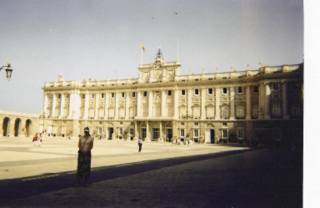
And here's my buddy Laura looking shady in front of the Palace de Real in Madrid. Amazing art all through out. Really drove home the awesome power of Spain in its heyday. The best part of the palace was the 1000 square feet Oriental carpets...I guess if you can't have hard-wood, it's the next best thing.
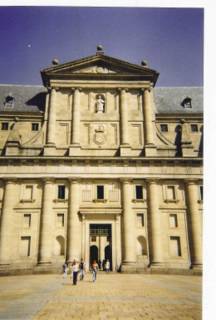
The little white speck is Laura standing in the back door of the monastery, palace, library and crypt called El Escorial. So much I could say about this place. Honestly, one of the most astounding places I have ever been. Just when you thought you had seen the last stunningly amazing room, there was another hallway with five more. (Yes, I know I am over-using adjectives here....But they were made for El Escorial.) In the end, the place was a strong faith affirmation for me. How much more people used to believe, than we do now! Imagine a head of state, building a monastery just to make sure that his family would get prayers.... This place is halfway between Avila and Madrid. If you get to Spain it's a must see. Heck, it's a must see even if you aren't going to Spain. Go, just to see this place.
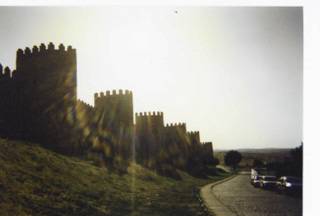
A shot of the wall that circles the old city of Avila. Laura and I spent a half a day trudging around every corner of the old city, in the heat, trying to find the Monastery of St. Teresa. I think it is called "Incarnacion." Well, we would trudge for about twenty minutes, and then stop and gasp to some friendly Spaniard, "Incarnacion?" They would shake their heads, point, and rattle off directions in speed-of-light Spanish. We would say "Gracias," and then trudge off again futilely. One detour did take us to the crumbling little church in which the saint, I will always think of as "Big T", was baptized. Finally, we figured out that the monastry is OUTSIDE the walls. We got there just as they were closing for the night, but we did get to step inside the confessional in which John of the Cross used to hear the nuns confessions. It was an odd end to an odd day. Good, but undeniably odd.
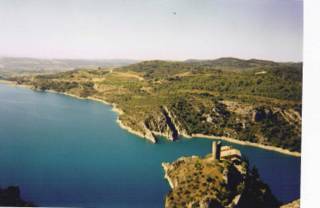
Gorgeous Torreciudad, a Marian shrine somewhere between Madrid and Barcelona. This shot is actually taken from the cool new shrine and conference center on the over-looking hill. The tower and building in the bottom right are the original Medieval tower and Church. It was originally some kind of miracle about Mary interceding to hold back the Religion of Peace from annilhating all the infidels in the region. Hmmm...We'll take one of those, please...
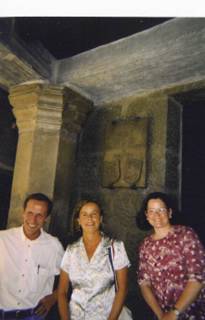
Our kind guides, Alvaro and Cristina, with friend Pat, standing by a rare plaque on a saint's house in Barbastro. The Spanish don't seem to get the idea of plaques. As Cristina noted to me with a shrug, "We would have to have a plaque on every building on every corner. (Damn Europeans with their smug overload of historical significance.)
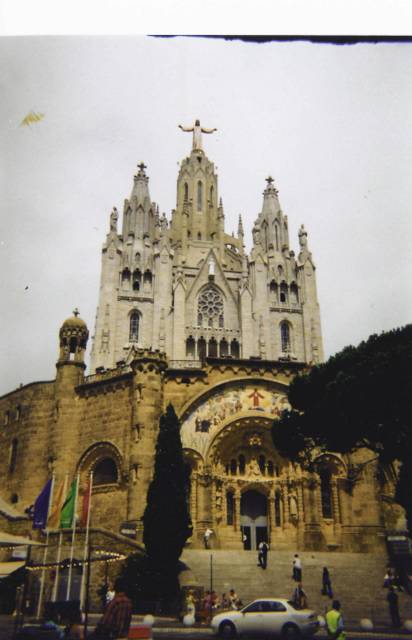
Here's Holy Family Church on a mountain overlooking Barcelona. This church was totally funded by the local people. It's lovely inside. Modern good.
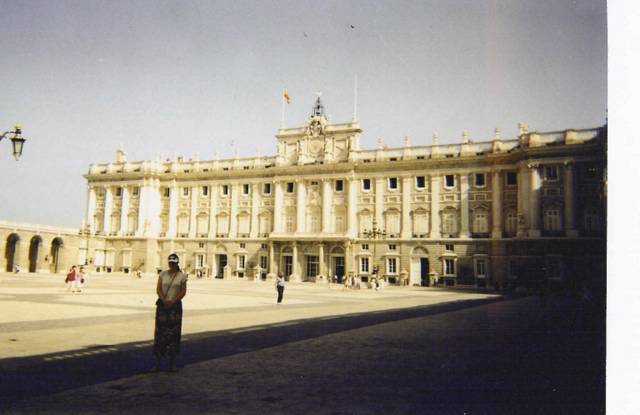
And here's my buddy Laura looking shady in front of the Palace de Real in Madrid. Amazing art all through out. Really drove home the awesome power of Spain in its heyday. The best part of the palace was the 1000 square feet Oriental carpets...I guess if you can't have hard-wood, it's the next best thing.

The little white speck is Laura standing in the back door of the monastery, palace, library and crypt called El Escorial. So much I could say about this place. Honestly, one of the most astounding places I have ever been. Just when you thought you had seen the last stunningly amazing room, there was another hallway with five more. (Yes, I know I am over-using adjectives here....But they were made for El Escorial.) In the end, the place was a strong faith affirmation for me. How much more people used to believe, than we do now! Imagine a head of state, building a monastery just to make sure that his family would get prayers.... This place is halfway between Avila and Madrid. If you get to Spain it's a must see. Heck, it's a must see even if you aren't going to Spain. Go, just to see this place.

A shot of the wall that circles the old city of Avila. Laura and I spent a half a day trudging around every corner of the old city, in the heat, trying to find the Monastery of St. Teresa. I think it is called "Incarnacion." Well, we would trudge for about twenty minutes, and then stop and gasp to some friendly Spaniard, "Incarnacion?" They would shake their heads, point, and rattle off directions in speed-of-light Spanish. We would say "Gracias," and then trudge off again futilely. One detour did take us to the crumbling little church in which the saint, I will always think of as "Big T", was baptized. Finally, we figured out that the monastry is OUTSIDE the walls. We got there just as they were closing for the night, but we did get to step inside the confessional in which John of the Cross used to hear the nuns confessions. It was an odd end to an odd day. Good, but undeniably odd.
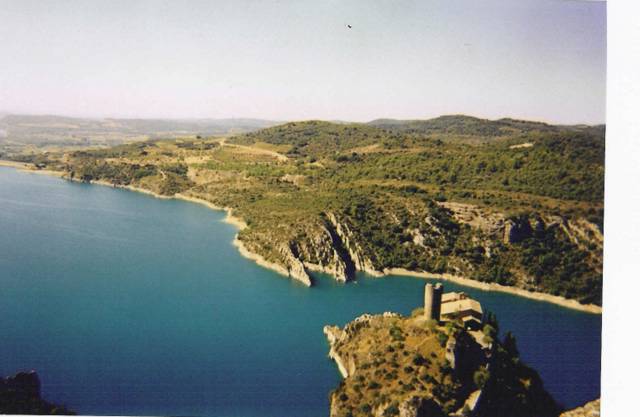
Gorgeous Torreciudad, a Marian shrine somewhere between Madrid and Barcelona. This shot is actually taken from the cool new shrine and conference center on the over-looking hill. The tower and building in the bottom right are the original Medieval tower and Church. It was originally some kind of miracle about Mary interceding to hold back the Religion of Peace from annilhating all the infidels in the region. Hmmm...We'll take one of those, please...
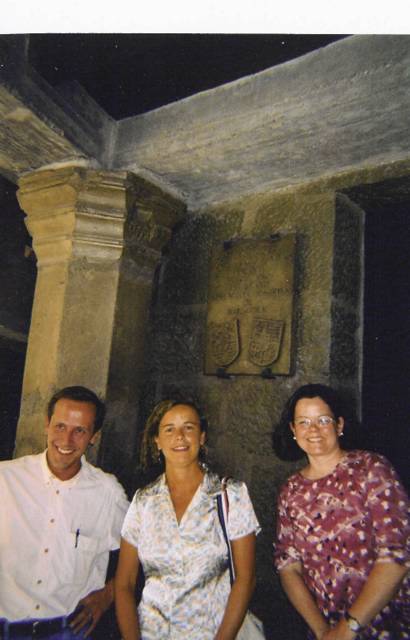
Our kind guides, Alvaro and Cristina, with friend Pat, standing by a rare plaque on a saint's house in Barbastro. The Spanish don't seem to get the idea of plaques. As Cristina noted to me with a shrug, "We would have to have a plaque on every building on every corner. (Damn Europeans with their smug overload of historical significance.)
CONSIDERED AS ORATORY...
...I was actually fairly impressed with W's speech last night. Judging from the lack of focus that the major networks are giving to the speech on this, the morning after, I have to conclude that my impression is correct. I've been sitting here flipping between Katie, Matt, Al and Anne, Charlie and Diane and the Ted Turner team, through three different news updates, and I haven't seen one mention of the speech yet. That absolutely qualifies as high praise, I think. You have to contrast this kind of sulking with the ad nauseum analsis of Kerry's lip-licking speech last month. (Just now, for example, I am watching Katie do a spot on "fall planting." Diane and Charlie are making a pie with Farrah Faucett! How I love it!)
Bush is not a man to be underestimated. He clearly practiced for this speech and delivered one far beyond anything I have ever heard from him.
The main drawbacks in the speech came from its length, and then the way it fell into the Clintonian style of dialogue with the audience. I think both of these were principally the fault of the assembled GOP faithful, however. Bush was interrupted 102 times in his speech by the assenting hoards, eager to show the Donkey party, "Yes, Yes, Yes, we do! We've got spirit, how 'bout you!" This clearly added probably ten to fifteen minutes to Bush's comments. I think this trend for the audience have to keep responding to a political speech at the end of every sentence is going to have to be dealt with in an unambiguous way to free audiences from the need to demonstrate their support every thirty seconds. It is really destroying political oratory. Somebody is going to have to say from the podium, "Please try and hold your applause until my comments are done." Or "Hey, this is MY speech." Or something gentle like that.
Still, I thought that Bush went on a bit long in thanking the military. It made for one of the most moving moments in the speech, but it was also handled at two points - once too many.
The two best things about the speech were the measured tone in which he spoke, and then, some of the great lines he put together. He countered his usual blubbering by taking his time, and clearly emphasing every word. This projects as a voice of authority, and principled convictions. I counter it to Kerry's kind of mad dash through his points, moving from sentence to sentence without any seeming hierarchy to his ideas. Bush's speech was longer, but Kerry's was much more tedious, because it didn't have any kind of structure.
In terms of structure, Bush moved from the particular to the philosophical, giving the closing moments a compelling touch of idealism. It made the speech an effective blend of policy and thematics - or both style and substance - always the best kind of oratory. And his theme was clear and strong: If you vote for me, you vote for someone who believes that the promotion of American style freedom - both at home and abroad - is the only way to secure peace and prosperity.
By contrast, I'm not sure I could find a clear, coherent theme underlying Kerry's speech. It was something like, "If you vote for me, you get well, not George Bush."
Bush also smartly avoided the hand-waving and gesturing that Kerry utilized to try and establish himself as "a warm and regular guy like us." Frankly, I think most Americans don't want someone like themselves in the Oval Office. It's like my friend Karen used to say about God, "I'd rather not have a Deity I could figure out, actually." Bush stood straight behind the podium, neither gripping it or leaning on it, keeping all the focus on his face and voice. And it's not a bad looking face, I think.
Whoever wrote the speech deserves mucho Kudos for some of the idea formulations. A couple of phrases really have the potential to become quotable: "I believe in the transformational power of liberty." And my favorite, referring to education policy for the poor as being a challenge to "the soft bigotry of low expectations." Fabulous!
I also thought it was a sign of courage how he addressed the hard issues of his decisions about Iraq head on, bringing together all the history and reasoning surrounding it. It was good to hear the real reason for the War stated so clearly and compellingly: We are gambling that a democratic state in the midst of the Arab world, will change the course of histroy for the good. America really can make no other gamble and be herself.
I thought he could have left out one or two of his comparisions to himself and Kerry, it reached the level of a sneer a couple of times, and this seems to me to be beneath the Chrief Executive. On the other hand, I do appreciate his frustrtaion. Somebody has to talk about Kerry's voting record. Kerry himself will surely not do it.
Overall, it was a very good piece of oratory. I predict a measurable post-convention bounce.
...I was actually fairly impressed with W's speech last night. Judging from the lack of focus that the major networks are giving to the speech on this, the morning after, I have to conclude that my impression is correct. I've been sitting here flipping between Katie, Matt, Al and Anne, Charlie and Diane and the Ted Turner team, through three different news updates, and I haven't seen one mention of the speech yet. That absolutely qualifies as high praise, I think. You have to contrast this kind of sulking with the ad nauseum analsis of Kerry's lip-licking speech last month. (Just now, for example, I am watching Katie do a spot on "fall planting." Diane and Charlie are making a pie with Farrah Faucett! How I love it!)
Bush is not a man to be underestimated. He clearly practiced for this speech and delivered one far beyond anything I have ever heard from him.
The main drawbacks in the speech came from its length, and then the way it fell into the Clintonian style of dialogue with the audience. I think both of these were principally the fault of the assembled GOP faithful, however. Bush was interrupted 102 times in his speech by the assenting hoards, eager to show the Donkey party, "Yes, Yes, Yes, we do! We've got spirit, how 'bout you!" This clearly added probably ten to fifteen minutes to Bush's comments. I think this trend for the audience have to keep responding to a political speech at the end of every sentence is going to have to be dealt with in an unambiguous way to free audiences from the need to demonstrate their support every thirty seconds. It is really destroying political oratory. Somebody is going to have to say from the podium, "Please try and hold your applause until my comments are done." Or "Hey, this is MY speech." Or something gentle like that.
Still, I thought that Bush went on a bit long in thanking the military. It made for one of the most moving moments in the speech, but it was also handled at two points - once too many.
The two best things about the speech were the measured tone in which he spoke, and then, some of the great lines he put together. He countered his usual blubbering by taking his time, and clearly emphasing every word. This projects as a voice of authority, and principled convictions. I counter it to Kerry's kind of mad dash through his points, moving from sentence to sentence without any seeming hierarchy to his ideas. Bush's speech was longer, but Kerry's was much more tedious, because it didn't have any kind of structure.
In terms of structure, Bush moved from the particular to the philosophical, giving the closing moments a compelling touch of idealism. It made the speech an effective blend of policy and thematics - or both style and substance - always the best kind of oratory. And his theme was clear and strong: If you vote for me, you vote for someone who believes that the promotion of American style freedom - both at home and abroad - is the only way to secure peace and prosperity.
By contrast, I'm not sure I could find a clear, coherent theme underlying Kerry's speech. It was something like, "If you vote for me, you get well, not George Bush."
Bush also smartly avoided the hand-waving and gesturing that Kerry utilized to try and establish himself as "a warm and regular guy like us." Frankly, I think most Americans don't want someone like themselves in the Oval Office. It's like my friend Karen used to say about God, "I'd rather not have a Deity I could figure out, actually." Bush stood straight behind the podium, neither gripping it or leaning on it, keeping all the focus on his face and voice. And it's not a bad looking face, I think.
Whoever wrote the speech deserves mucho Kudos for some of the idea formulations. A couple of phrases really have the potential to become quotable: "I believe in the transformational power of liberty." And my favorite, referring to education policy for the poor as being a challenge to "the soft bigotry of low expectations." Fabulous!
I also thought it was a sign of courage how he addressed the hard issues of his decisions about Iraq head on, bringing together all the history and reasoning surrounding it. It was good to hear the real reason for the War stated so clearly and compellingly: We are gambling that a democratic state in the midst of the Arab world, will change the course of histroy for the good. America really can make no other gamble and be herself.
I thought he could have left out one or two of his comparisions to himself and Kerry, it reached the level of a sneer a couple of times, and this seems to me to be beneath the Chrief Executive. On the other hand, I do appreciate his frustrtaion. Somebody has to talk about Kerry's voting record. Kerry himself will surely not do it.
Overall, it was a very good piece of oratory. I predict a measurable post-convention bounce.
BEAUTY AS 'A TRAP' IN THE EYE OF THE BELIEVER
David "Nihil Obstat" Impastato, sent me the following message as answer to my question about Europeans Christians surrounded by artistic beauty, but losing their faith. I love love love the Simone Weil quote. Thanks, David!
I agree with your ongoing contention, that beauty
must return to the Church. It’s an uphill battle, of course, since
contemporary ecclesiology, as taught in our seminaries, explicitly sees
aesthetic beauty as an obstacle to creating moral beauty and the sense of
“community” that liturgy (under the new dispensation) is supposed to
foster. This is an old reformation argument, which accounted for the
reformation’s iconoclastic tendency, and now accounts for ours.
In an incarnational faith, it is absurd to say that physical beauty has
no place. We are creative beings made in the image of a Creator God whose
being is embedded in the beauty of the world and indeed wherever beauty
is encountered. But the experience of the Church has been that a good
number of her communicants in the past have allowed aesthetic beauty to
define the limits of their connection with the liturgy, just as you
observed currently in Spain. Random european example from a century ago:
despite his clamorous apostasy, Ulysses’ author James Joyce faithfully
attended Easter services, especially Tenebrae, just to be ravished by
beauty. This was and is related to the concurrent phenomenon in secular
humanism to see Art (upper case) as the domain of a non-theistic
spirituality -- i.e., Art as the new religion.
These developments have made aesthetic beauty suspect in a religious
setting . But Catholicism has been, at least till now, a “both/and”
tradition. The reformation preference for “either/or” (grace OR works,
stained glass windows OR inner light) need not be our guide. What we can
and must revive is a “both/and” paradigm of beauty AND faith, which has
been our perennial tradition.
Simone Weil said, “Beauty is the trap God sets for us.” But as the
European faith in God has waned, beauty has become its own end, no longer
a means of spiriting us off to the Alpha and Omega of all that is
beautiful. True, beauty can sometimes lead us to faith in an epiphany of
grace. But generally speaking, we must first nurture a connection
between Ultimate Beauty and our physical universe at a more fundamental
level. “This is my Body” is such a connection, one of the great gifts
given us to enter the sacred trap.
David "Nihil Obstat" Impastato, sent me the following message as answer to my question about Europeans Christians surrounded by artistic beauty, but losing their faith. I love love love the Simone Weil quote. Thanks, David!
I agree with your ongoing contention, that beauty
must return to the Church. It’s an uphill battle, of course, since
contemporary ecclesiology, as taught in our seminaries, explicitly sees
aesthetic beauty as an obstacle to creating moral beauty and the sense of
“community” that liturgy (under the new dispensation) is supposed to
foster. This is an old reformation argument, which accounted for the
reformation’s iconoclastic tendency, and now accounts for ours.
In an incarnational faith, it is absurd to say that physical beauty has
no place. We are creative beings made in the image of a Creator God whose
being is embedded in the beauty of the world and indeed wherever beauty
is encountered. But the experience of the Church has been that a good
number of her communicants in the past have allowed aesthetic beauty to
define the limits of their connection with the liturgy, just as you
observed currently in Spain. Random european example from a century ago:
despite his clamorous apostasy, Ulysses’ author James Joyce faithfully
attended Easter services, especially Tenebrae, just to be ravished by
beauty. This was and is related to the concurrent phenomenon in secular
humanism to see Art (upper case) as the domain of a non-theistic
spirituality -- i.e., Art as the new religion.
These developments have made aesthetic beauty suspect in a religious
setting . But Catholicism has been, at least till now, a “both/and”
tradition. The reformation preference for “either/or” (grace OR works,
stained glass windows OR inner light) need not be our guide. What we can
and must revive is a “both/and” paradigm of beauty AND faith, which has
been our perennial tradition.
Simone Weil said, “Beauty is the trap God sets for us.” But as the
European faith in God has waned, beauty has become its own end, no longer
a means of spiriting us off to the Alpha and Omega of all that is
beautiful. True, beauty can sometimes lead us to faith in an epiphany of
grace. But generally speaking, we must first nurture a connection
between Ultimate Beauty and our physical universe at a more fundamental
level. “This is my Body” is such a connection, one of the great gifts
given us to enter the sacred trap.
Thursday, September 02, 2004
DISNEY: CAN THEY POSSIBLY GET ASLAN?
The folks at Disney are probably almost ready to assume psotures of prayer that the upcoming Narnia films will put the Mousehouse back on the map as THE top source of family entertainment. Cut out of the ultra successful Harry Potter and LOTR franchises, and having blown its relationship to the amazing Pixar studios, Disney really really really understands what it means to be the studio where "it is always winter but never Christmas."
The trades just released the complete cast and crew listing for the project. There have been four writers on the project which is generally not a great sign. (Don't know if it's true or Hollywood Christian legend, but I heard that the original writer was so disconnected from the Christian themes in the work, that she left out the whole stone table sequence as not essential. I had interviewed this writer several years ago about another project and couldn't quite get her to acknowledge that she was a Christian. This is problematic because, Narnia, unlike Tolkien's Fellowship is absolutely allegorical. You can't just ignore the meanings behind the story and mess with them, or the whole thing will be rendered absurd. It would be an incredible act of faith to expect someone with no religious faith to be able to do this adaptation.)
Anyway, here is the report from Specter about the cast and crew for the film.
The film marks the first live-action directorial effort for New Zealander
Andrew Adamson (the Oscar(r)-winning "Shrek," "Shrek 2"), who also co-wrote
the screenplay adaptation with Emmy Award-winner Anne Peacock (HBO's "A
Lesson Before Dying") and scribes Christopher Markus and Stephen McFeely
(HBO's "The Life and Death of Peter Sellers"). The film is produced by
Academy Award(r)-winning filmmaker Mark Johnson ("Rain Man," "Bugsy," "A
Little Princess," "The Notebook") and is slated for a global release in
December, 2005, through the Walt Disney Studios distribution division of
Buena Vista Releasing.
Already in the planning and preproduction stages for two years, the
project's towering production schedule of eighteen months encompasses a
six-month live-action shoot followed by a yearlong post-production schedule
leading to its December, 2005, worldwide release. To bring his dazzling
vision to the screen, Adamson has secured the talents of Oscar-nominated
cinematographer Donald McAlpine, A.S.C., A.C.S ("Moulin Rouge," "Peter
Pan"), Oscar(r)-nominated production designer Roger Ford ("Babe," "Peter
Pan"), seasoned costume designer Isis Mussenden ("Shrek," "Shrek 2," "Dirty
Dancing: Havana Nights"), film editors Sim Evan-Jones ("Shrek") and Jim May
("Van Helsing") and composer Harry Gregson-Williams ("Shrek," "Shrek 2,"
"Antz"). Industry veteran Philip Steuer ("The Alamo," "The Rookie") joins
director Adamson as the film's executive producer.
Inspired by Lewis' imaginative creations, the story's human cast will be
complemented by a gallery of original and wondrous characters and creatures
portrayed onscreen in the combined efforts of live-action and CGI animation
under the supervision of visual effects supervisor Dean Wright ("The Lord
of the Rings: The Return of the King") and VFX producer Randy Starr. They
will collaborate with the movie magicians at two of Hollywood's VFX giants:
Sony Imageworks ("Spider-Man 2") and Rhythm & Hues (the Academy
Award(r)-winning "Babe"), whose dazzling array of computer-generated
effects will breed such creatures as the mighty lion king, Aslan; Mr. and
Mrs. Beaver, the kindly mammals who accompany the children on their
journey; Maugrim, the savage gray wolf who serves as the White Witch's
henchman; and a host of other beasts including minotaurs, centaurs,
cyclops, and broods of others not before seen on the motion picture screen.
The film's creative team also includes four-time Academy Award(r)-winning
visualist Richard Taylor ("Lord of the Rings" trilogy, "Heavenly
Creatures") and the wizards from his Weta Workshop, a collective group of
artists based in New Zealand who designed and created the visual and makeup
effects for all three chapters of Jackson's landmark movie trilogy.
Taylor's team (who designed the film's armour and weaponry, with early
creature concepts) will team up with veteran movie makeup magicians Howard
Berger and Greg Nicotero, partners in the award-winning company of KNB EFX
Group, who will manufacture and apply hundreds of special makeup
prosthetics for all of the unique and unusual characters in the story.
Acclaimed cast drawn from both international and local New Zealand talent
Starring in the film is acclaimed, award-winning actress Tilda Swinton
("The Deep End," "Orlando," "Constantine") as Jadis, the powerful, evil
White Witch. Joining Swinton as the Pevensie children are screen newcomer
Georgie Henley as Lucy, the youngest of the quartet and the first to enter
the portal to the magical land of Narnia; Skandar Keynes as Edmund, the
younger boy who follows Lucy into Narnia, only to fall under the bewitching
spell of the White Witch; seasoned British actress Anna Popplewell ("The
Girl with A Pearl Earring," "Mansfield Park") as Susan, the cautious and
practical older sister skeptical about entering the kingdom of Narnia; and,
in his motion picture debut, William Moseley ("Goodbye, Mr. Chips") as
Peter, the eldest of the siblings whom the others look to for leadership
during their adventurous journey.
Co-starring in the film are Scottish actor James McAvoy (HBO's "Band of
Brothers," "Wimbledon") as Mr. Tumnus, the kindhearted faun (half-man,
half-goat) who risks his own fate to ensure Lucy's safety in Narnia;
diminutive British talent Kiran Shah ("Lord of the Rings," "Raiders of the
Lost Ark") who portrays Ginarrbrik, the White Witch's dwarfish sleigh
driver; Best Supporting Actor Oscar winner Jim Broadbent ("Iris," "Moulin
Rouge!," "Gangs of New York," "Topsy-Turvy"), who appears as Prof. Kirke,
whose lavish country home houses the magical wardrobe; and veteran Scottish
performer James Cosmo ("Troy," "Braveheart") as Father Christmas.
Adamson has also cast several Kiwi performers to portray a variety of human
and Narnian creatures in the film, including Judy McIntosh ("Arriving
Tuesday," Ngati") as the matriarch of the Pevensie family; Elizabeth
Hawthorne ("The Frighteners," "The Tommyknockers") as Mrs. MacReady, the
caretaker of the mansion; Patrick Kake ("Hercules: The Legendary Journeys")
as Oreius, Aslan's head Centaur; and Shane Rangi ("Lord of the Rings") as
Gen. Otman, the fierce Minotaur and leader of the White Witch's army.
To bring the story's magically computer-animated creations to life, Adamson
has cast a host of acclaimed performers to lend their vocal talents to the
film, including Ray Winstone ("Sexy Beast," "King Arthur") as Mr. Beaver;
Rupert Everett ("The Madness of King George," "My Best Friend's Wedding,"
"Shrek 2") as The Fox, another ally of the children; and veteran British
comedienne Dawn French ("The Adventures of Pinocchio," "Harry Potter and
the Prisoner of Azkaban," BBC's "The Vicar of Dibley") as Mrs. Beaver.
Additional casting announcements are forthcoming, including that of Aslan
the Lion.
I am pretty amazed at the absence of real big stars. There isn't one A-list here, which could also be an indictment of the script. Great scripts tend to attract big stars.
I'm trying to be hopeful about the project, but I think we could all send a few prayers its way.
The folks at Disney are probably almost ready to assume psotures of prayer that the upcoming Narnia films will put the Mousehouse back on the map as THE top source of family entertainment. Cut out of the ultra successful Harry Potter and LOTR franchises, and having blown its relationship to the amazing Pixar studios, Disney really really really understands what it means to be the studio where "it is always winter but never Christmas."
The trades just released the complete cast and crew listing for the project. There have been four writers on the project which is generally not a great sign. (Don't know if it's true or Hollywood Christian legend, but I heard that the original writer was so disconnected from the Christian themes in the work, that she left out the whole stone table sequence as not essential. I had interviewed this writer several years ago about another project and couldn't quite get her to acknowledge that she was a Christian. This is problematic because, Narnia, unlike Tolkien's Fellowship is absolutely allegorical. You can't just ignore the meanings behind the story and mess with them, or the whole thing will be rendered absurd. It would be an incredible act of faith to expect someone with no religious faith to be able to do this adaptation.)
Anyway, here is the report from Specter about the cast and crew for the film.
The film marks the first live-action directorial effort for New Zealander
Andrew Adamson (the Oscar(r)-winning "Shrek," "Shrek 2"), who also co-wrote
the screenplay adaptation with Emmy Award-winner Anne Peacock (HBO's "A
Lesson Before Dying") and scribes Christopher Markus and Stephen McFeely
(HBO's "The Life and Death of Peter Sellers"). The film is produced by
Academy Award(r)-winning filmmaker Mark Johnson ("Rain Man," "Bugsy," "A
Little Princess," "The Notebook") and is slated for a global release in
December, 2005, through the Walt Disney Studios distribution division of
Buena Vista Releasing.
Already in the planning and preproduction stages for two years, the
project's towering production schedule of eighteen months encompasses a
six-month live-action shoot followed by a yearlong post-production schedule
leading to its December, 2005, worldwide release. To bring his dazzling
vision to the screen, Adamson has secured the talents of Oscar-nominated
cinematographer Donald McAlpine, A.S.C., A.C.S ("Moulin Rouge," "Peter
Pan"), Oscar(r)-nominated production designer Roger Ford ("Babe," "Peter
Pan"), seasoned costume designer Isis Mussenden ("Shrek," "Shrek 2," "Dirty
Dancing: Havana Nights"), film editors Sim Evan-Jones ("Shrek") and Jim May
("Van Helsing") and composer Harry Gregson-Williams ("Shrek," "Shrek 2,"
"Antz"). Industry veteran Philip Steuer ("The Alamo," "The Rookie") joins
director Adamson as the film's executive producer.
Inspired by Lewis' imaginative creations, the story's human cast will be
complemented by a gallery of original and wondrous characters and creatures
portrayed onscreen in the combined efforts of live-action and CGI animation
under the supervision of visual effects supervisor Dean Wright ("The Lord
of the Rings: The Return of the King") and VFX producer Randy Starr. They
will collaborate with the movie magicians at two of Hollywood's VFX giants:
Sony Imageworks ("Spider-Man 2") and Rhythm & Hues (the Academy
Award(r)-winning "Babe"), whose dazzling array of computer-generated
effects will breed such creatures as the mighty lion king, Aslan; Mr. and
Mrs. Beaver, the kindly mammals who accompany the children on their
journey; Maugrim, the savage gray wolf who serves as the White Witch's
henchman; and a host of other beasts including minotaurs, centaurs,
cyclops, and broods of others not before seen on the motion picture screen.
The film's creative team also includes four-time Academy Award(r)-winning
visualist Richard Taylor ("Lord of the Rings" trilogy, "Heavenly
Creatures") and the wizards from his Weta Workshop, a collective group of
artists based in New Zealand who designed and created the visual and makeup
effects for all three chapters of Jackson's landmark movie trilogy.
Taylor's team (who designed the film's armour and weaponry, with early
creature concepts) will team up with veteran movie makeup magicians Howard
Berger and Greg Nicotero, partners in the award-winning company of KNB EFX
Group, who will manufacture and apply hundreds of special makeup
prosthetics for all of the unique and unusual characters in the story.
Acclaimed cast drawn from both international and local New Zealand talent
Starring in the film is acclaimed, award-winning actress Tilda Swinton
("The Deep End," "Orlando," "Constantine") as Jadis, the powerful, evil
White Witch. Joining Swinton as the Pevensie children are screen newcomer
Georgie Henley as Lucy, the youngest of the quartet and the first to enter
the portal to the magical land of Narnia; Skandar Keynes as Edmund, the
younger boy who follows Lucy into Narnia, only to fall under the bewitching
spell of the White Witch; seasoned British actress Anna Popplewell ("The
Girl with A Pearl Earring," "Mansfield Park") as Susan, the cautious and
practical older sister skeptical about entering the kingdom of Narnia; and,
in his motion picture debut, William Moseley ("Goodbye, Mr. Chips") as
Peter, the eldest of the siblings whom the others look to for leadership
during their adventurous journey.
Co-starring in the film are Scottish actor James McAvoy (HBO's "Band of
Brothers," "Wimbledon") as Mr. Tumnus, the kindhearted faun (half-man,
half-goat) who risks his own fate to ensure Lucy's safety in Narnia;
diminutive British talent Kiran Shah ("Lord of the Rings," "Raiders of the
Lost Ark") who portrays Ginarrbrik, the White Witch's dwarfish sleigh
driver; Best Supporting Actor Oscar winner Jim Broadbent ("Iris," "Moulin
Rouge!," "Gangs of New York," "Topsy-Turvy"), who appears as Prof. Kirke,
whose lavish country home houses the magical wardrobe; and veteran Scottish
performer James Cosmo ("Troy," "Braveheart") as Father Christmas.
Adamson has also cast several Kiwi performers to portray a variety of human
and Narnian creatures in the film, including Judy McIntosh ("Arriving
Tuesday," Ngati") as the matriarch of the Pevensie family; Elizabeth
Hawthorne ("The Frighteners," "The Tommyknockers") as Mrs. MacReady, the
caretaker of the mansion; Patrick Kake ("Hercules: The Legendary Journeys")
as Oreius, Aslan's head Centaur; and Shane Rangi ("Lord of the Rings") as
Gen. Otman, the fierce Minotaur and leader of the White Witch's army.
To bring the story's magically computer-animated creations to life, Adamson
has cast a host of acclaimed performers to lend their vocal talents to the
film, including Ray Winstone ("Sexy Beast," "King Arthur") as Mr. Beaver;
Rupert Everett ("The Madness of King George," "My Best Friend's Wedding,"
"Shrek 2") as The Fox, another ally of the children; and veteran British
comedienne Dawn French ("The Adventures of Pinocchio," "Harry Potter and
the Prisoner of Azkaban," BBC's "The Vicar of Dibley") as Mrs. Beaver.
Additional casting announcements are forthcoming, including that of Aslan
the Lion.
I am pretty amazed at the absence of real big stars. There isn't one A-list here, which could also be an indictment of the script. Great scripts tend to attract big stars.
I'm trying to be hopeful about the project, but I think we could all send a few prayers its way.
PASSION REDUX
The big news in Hollywood this week ISN'T the Republican convention. There's a little DVD release this week that is making everybody uncomfortable again. Basically because it looks to be shattering records, just like it did in theaters back in February.
The Passion of the Christ DVD started selling on Tuesday morning, and, by lunch, had sold 2.5 million copies. The figures will just keep going up, in the next few weeks. You can almost hear the studio marketing departments popping aspirin, "Why won't this movie just go away?!"
It's hard to measure the impact of Passion, but we do know that even before the DVD release, one third of American adults had already seen the film. That number will probably double now that the film is on DVD. Kind of an astounding number. A recent Barna poll found that one in ten people who saw the film said it had changed their religious beliefs. 18% of those viewing the film said it had positively impacted their life of faith, and another 16% said it had changed their religious practices.
As I said last June when I first saw the roughcut of the film, "The Passion is a miracle."
The big news in Hollywood this week ISN'T the Republican convention. There's a little DVD release this week that is making everybody uncomfortable again. Basically because it looks to be shattering records, just like it did in theaters back in February.
The Passion of the Christ DVD started selling on Tuesday morning, and, by lunch, had sold 2.5 million copies. The figures will just keep going up, in the next few weeks. You can almost hear the studio marketing departments popping aspirin, "Why won't this movie just go away?!"
It's hard to measure the impact of Passion, but we do know that even before the DVD release, one third of American adults had already seen the film. That number will probably double now that the film is on DVD. Kind of an astounding number. A recent Barna poll found that one in ten people who saw the film said it had changed their religious beliefs. 18% of those viewing the film said it had positively impacted their life of faith, and another 16% said it had changed their religious practices.
As I said last June when I first saw the roughcut of the film, "The Passion is a miracle."
SEE BARBARA HALL...AND ME.
The Christian Hollywood network, Inter-Mission, is having an evening with Barbara Hall (Emmy Nominated Creator and Exec Producer, Joan of Arcadia) later this month. They called and asked me to be the interviewer, as, well, the lesser of two Barbaras.
At first I hesitated, because, having been Barb's RCIA instructor, we have a different kind of relationship. We talk about God, not show biz. But Barbara said, "Sure, sounds fun," so I'll be doing the questioning honors. It should be pretty fun. For me, anyway. Barb is one of those people whose attention it is flattering just to have. I am going to try and make it a different interview for her than the same old same old she gets pretty much everywhere she goes. See if we can't make her laugh.
Anyway, here's the info for the night Inter-Mission is calling,
“What if God was one of us…”
Join creator and executive producer, Barbara Hall, for the first event of the new 2004-2005 season featuring the Emmy nominated drama series, JOAN OF ARCADIA.
What if God suddenly began talking to you in human form? Would you tell anyone? Would others think you were crazy? Joan decides to follow God’s advice, keeping it hidden from her police chief father (Joe Mantegna), her inquisitive mother (Mary Steenburgen), her geeky younger brother (Michael Welch) and her older brother, a former football star now paralyzed by a car accident (Jason Ritter).
How many ways have we unknowingly encountered God? What are ways God uses to get our attention? The multi-Emmy nominated Hall brings her faith into a hit TV show in a piece of entertainment that inspires more questions than it answers.
Depite the fact that there were few women writers in TV in the early 80s, Hall sold her first story to FAMILY TIES and was soon hired by NEWHART as a comedy writer before being promoted to story editor. Disliking the roundtable format of comedy writing, Hall switched to the more personal medium of television drama (JUDGING AMY, CHICAGO HOPE, MOONLIGHTING, and I'LL FLY AWAY). Through both comedy and drama, Barbara has entertained Television viewers over 20 years. Discover how this believer has been able to mesh her career and beliefs to not only survive but thrive in the entertainment industry.
SCHEDULE
6:30-7:30
Catered Dinner (Your choice of Grilled Salmon with Basil Aioli Sauce OR Wild Mushroom Pasta entrée, Fresh Steamed Vegetables, Garden Salad, Fresh Baked Bread & Finger Dessert)
7:30-8:30
Emmy nominated episode of JOAN OF ARCADIA
8:30-9:30
Interview with Barbara Hall
9:30-10:00
Mix-n-Mingle
WHEN:
Monday, Sept. 27, 2004
WHERE:
Henrietta Mears Center
First Presbyterian Church of Hollywood. 1760 N. Gower St. Hollywood, CA 90028
RSVP:
1) 323-462-8460 x333
OR
2) Register On-Line
DINNER REGISTRATION DEADLINE: Thursday, September 23
Members
$15 Dinner & Program
$8 Program Only
Non-Members
$20 Dinner & Program
$10 Program Only
The Christian Hollywood network, Inter-Mission, is having an evening with Barbara Hall (Emmy Nominated Creator and Exec Producer, Joan of Arcadia) later this month. They called and asked me to be the interviewer, as, well, the lesser of two Barbaras.
At first I hesitated, because, having been Barb's RCIA instructor, we have a different kind of relationship. We talk about God, not show biz. But Barbara said, "Sure, sounds fun," so I'll be doing the questioning honors. It should be pretty fun. For me, anyway. Barb is one of those people whose attention it is flattering just to have. I am going to try and make it a different interview for her than the same old same old she gets pretty much everywhere she goes. See if we can't make her laugh.
Anyway, here's the info for the night Inter-Mission is calling,
“What if God was one of us…”
Join creator and executive producer, Barbara Hall, for the first event of the new 2004-2005 season featuring the Emmy nominated drama series, JOAN OF ARCADIA.
What if God suddenly began talking to you in human form? Would you tell anyone? Would others think you were crazy? Joan decides to follow God’s advice, keeping it hidden from her police chief father (Joe Mantegna), her inquisitive mother (Mary Steenburgen), her geeky younger brother (Michael Welch) and her older brother, a former football star now paralyzed by a car accident (Jason Ritter).
How many ways have we unknowingly encountered God? What are ways God uses to get our attention? The multi-Emmy nominated Hall brings her faith into a hit TV show in a piece of entertainment that inspires more questions than it answers.
Depite the fact that there were few women writers in TV in the early 80s, Hall sold her first story to FAMILY TIES and was soon hired by NEWHART as a comedy writer before being promoted to story editor. Disliking the roundtable format of comedy writing, Hall switched to the more personal medium of television drama (JUDGING AMY, CHICAGO HOPE, MOONLIGHTING, and I'LL FLY AWAY). Through both comedy and drama, Barbara has entertained Television viewers over 20 years. Discover how this believer has been able to mesh her career and beliefs to not only survive but thrive in the entertainment industry.
SCHEDULE
6:30-7:30
Catered Dinner (Your choice of Grilled Salmon with Basil Aioli Sauce OR Wild Mushroom Pasta entrée, Fresh Steamed Vegetables, Garden Salad, Fresh Baked Bread & Finger Dessert)
7:30-8:30
Emmy nominated episode of JOAN OF ARCADIA
8:30-9:30
Interview with Barbara Hall
9:30-10:00
Mix-n-Mingle
WHEN:
Monday, Sept. 27, 2004
WHERE:
Henrietta Mears Center
First Presbyterian Church of Hollywood. 1760 N. Gower St. Hollywood, CA 90028
RSVP:
1) 323-462-8460 x333
OR
2) Register On-Line
DINNER REGISTRATION DEADLINE: Thursday, September 23
Members
$15 Dinner & Program
$8 Program Only
Non-Members
$20 Dinner & Program
$10 Program Only
JUST A LITTLE BIT OF GRIEF
For no discernible reason, my little cat, Tibby, went into seizures yesterday. It was awful. The poor cat has had a hell of a summer, back and forth to two different vets several time, but they just couldn't fix him. We brought him to the vet again last night but there was nothing they could really do. He was in so much pain he couldn't really move, in between the seizures.
So, I had to make the difficult call to have him put to sleep. It was pretty awful.
I grew up in a farming area back in RI, and we had many cats come and go. My family was grimly pragmatic about it: Pets were pets, not people, and you move on when they get run over or eaten by something bigger. So, I feel really foolish admitting that I am rather sad right now.
But Tibby was a great cat, really sweet and loving. I didn't want a cat, but then one day, there I was, asked to cat-sit for him by my Irish pastor when an old lady in our parish had a stroke. When the lady died, I ended up having to keep the cat, who took about one year to trust me, before moving into complete unadulterated adulation. He used to follow me around room to room just staring at me. He was certainly odd, didn't know how to do normal cat things like chase toys and meow, but he was absolutely gentle and eager to please. It's kind of weird that he didn't die while I was off in Spain. My roommate said, "It's like he waited for you to come back." Who knows what animals know?
He was a good companion in my early years out here in L.A. before I had a lot of friends. I'm going to miss him.
For no discernible reason, my little cat, Tibby, went into seizures yesterday. It was awful. The poor cat has had a hell of a summer, back and forth to two different vets several time, but they just couldn't fix him. We brought him to the vet again last night but there was nothing they could really do. He was in so much pain he couldn't really move, in between the seizures.
So, I had to make the difficult call to have him put to sleep. It was pretty awful.
I grew up in a farming area back in RI, and we had many cats come and go. My family was grimly pragmatic about it: Pets were pets, not people, and you move on when they get run over or eaten by something bigger. So, I feel really foolish admitting that I am rather sad right now.
But Tibby was a great cat, really sweet and loving. I didn't want a cat, but then one day, there I was, asked to cat-sit for him by my Irish pastor when an old lady in our parish had a stroke. When the lady died, I ended up having to keep the cat, who took about one year to trust me, before moving into complete unadulterated adulation. He used to follow me around room to room just staring at me. He was certainly odd, didn't know how to do normal cat things like chase toys and meow, but he was absolutely gentle and eager to please. It's kind of weird that he didn't die while I was off in Spain. My roommate said, "It's like he waited for you to come back." Who knows what animals know?
He was a good companion in my early years out here in L.A. before I had a lot of friends. I'm going to miss him.
Wednesday, September 01, 2004
THE GOOD THING ABOUT JET-LAG...
...is that it means that you can be wide awake at 4am, answering forty emails and catching up on your blogging. Ordinarily, I waste the hours between 4am and 6am, you know, sleeping. Rats.
Back in L.A. after eight days in Spain and Southern France.
We were also obliged by an overbooked Air France flight to spend an extra day enjoying cold French hospitality in a two-star hotel (read: ridiculously slow Internet access and room keys handed out with sneering haughtiness...what IS it with French people, anyway?!) in a small town just outside of Paris. (The town is Roissy. My companions tell me it was fatally quaint. I opted to sleep that last day, so all I have from Roissy is a bottle of champagne the mayor of the village presented to my friends. I really have no idea what THAT was about…)
Eight days: Madrid, Avila, El Escoriel, Zaragossa (my favorite place! more about it later...), Barbastro, Torrecidad, Barcelona, Montserrat, Andorra, the amazingly picturesque Pyrenees, Pau in France. Too much beautiful art in one week. I got saturated by mid-week, and found myself experiencing the unbelievable shrine at Montserrat the way my five year old nephew acted after six hours at Disneyland. Just kind of stumbling through, overwhelmed and certain that the world holds many more things in it than we can ever dream of or imagine. Way too many impressions to have them all straight yet, but here are a few thoughts that are strongest right now...
Once again, this visit has demonstrated to me that Spanish people are among the loveliest, warmest, most gracious and generous souls God created. I know that Spanish people must work for a living, but judging by the amount of time everybody gave us wherever we went, you would think they just sit around Medieval plazas all day, drinking coffee and waiting to escort clueless Americans anywhere, to do anything, for as long as it takes.
The purpose of our trip was for me to see some of the sights and terrain that will be the backdrop for the screenplay I am writing set during the Spanish Civil War. Special thanks for planning our every day, and finding me a stream of English speaking historians with whom to chat goes to the extraordinary (that would be one of my adjectives, Cristina) Cristina Fernandez Alonzo of Madrid. (I know it will be mortifying to her for me to thank her on the World Wide Web, but Cristina, that is the risk you take when you are busy about being amazingly kind and good...) Cristina, who produces a TV show and runs a charitable foundation for children, is one of those Christians who makes you feel really good about “our side.” If the Gospel produces people like this, it’s got to be real. Muchos gracias, Cristina!
Thanks also to all the people Cristina prevailed on to answer our questions and take us around - Beatrice and Pilar in Madrid, Alvarro in Zaragossa, Fr. Javier in Torrecidad (who was also the provider of Foie Gras one night!), Carmen in Barcelona, Damaso in the Pyrenees. Amazing generous people. I wish I could write a screenplay that would be half as worthy of all the kindnesses we received in our travels.
PARADOX: DOES TOO MUCH RELIGION MAKE GOD INVISIBLE?
The really good news is that the Church in Spain seems to be faring much better than in the rest of Europe. Daily Mass is well-attended, and Sunday Masses were quite crowded. There are a lot of thirty and forty somethings doing religious stuff - we saw them at all the shrines, kissing relics and touching statues and making quiet visits with Jesus and the members of the communion of saints who are at home in every crevice in most Spanish churches.
We couldn't help but contrast the evidence of Spanish faith with the absence of it in Andorra and France. Not sure how to account for the contrast, except for the comfortingly ubiquitous presence of the Madonna in Spain. She's there in every little village and region, wearing a different guise, but very much rallying the people around her Son. The other different thing about Spain, has to be reckoned the 35,000 members of Opus Dei who are out there in what is a relatively small nation, seriously pursuing personal holiness "in the streets," as St. Josemaria Escriva was wont to say.
Still, our Spanish friends assured us that there is a crisis of belief going on, even amidst the cultural omnipresence of God stuff there. The faith in Spain is so strongly cultural, that it has stopped being personal for most people. It's part of the people's tradition, but not necessarily part of every individual's journey.
An example of this was laid out for us during our visit to Zaragossa. By the way, an absolute MUST for anyone who treks to Spain. We were at the astounding Basilica which houses the miraculous statue of Our lady of Pilar, and our guide for the day, Alvaro, noted that the square and basilica would get really crowded very soon. Zaragossa's soccer team had won the national championship the night before, and now, the whole team, and town, were going to process into the basilica to present the trophy to the Virgin.
For me, it was such a stunning blend of the sacred with the secular. I was actually a little scandalized by the way Our Blessed Mother was draped in a soccer banner in the basilica. But that is my sick American "separation of faith and state" problem. I don't think she has a problem with it at all. In fact, I think the Divine was surely smiling down at all the people bringing their children to be photographed next to the Madonna of Pilar, up there wearing Zaragossa's team colors. (I bought a nice sized Our Lady of Pilar statue and brought it home. Tonight I am going to have a ritual ceremony of draping her in a Boston Red Sox T-shirt...oh, some of you think I am kidding...)
This leads me to what became the central paradox I chewed over as we moved from gorgeous churches in El Escoriel to to Madrid to Barcelona.
Everywhere I go here in the States, I whine and complain that we need beauty in our churches. I see it as a necessary component to weathering life in a holy way "in this valley of tears." So, here's the problem. Europe is chock-full of beauty in their churches, but they have mostly lost their faith.
So, what does that say about my theories about the urgent relationship between aestethical/liturgical beauty and faith? Maybe it is good that we Americans are surrounded by ugliness in our churches? Somebody help...
"I DON'T THINK YOU KNOW WHAT THAT WORD MEANS."
The word "hatred" has a much more serious connotation in Spain. This is a legacy of the Civil War, of course, which is still very much the story of many people's families there. We met one man most of whose family was killed by a group of Nationalists back in 1937 who were looking for communists. Seventy years later, the man still had sadness in his voice as he told us, "It was obvious they weren't communists because the house had all the saints in it." He meant statues. But he had no rancor. He shrugged to me, "We have to let it go." Anyway, the Spanish figured out in those three horrible years, that if people don't pass over and move on from their instinct for hatred, it will destroy everything.
I couldn't help but contrast the Spanish sense of hatred with the cavalier way we throw the word around here in the States, and especially in our politically polarized climate. I saw one sign in the NYC demonstartion last week with a picture of George W Bush and a sign reading "The Face of hate." No see, we really don't know what we are talking about. Hatred isn't something subtle and manageable. It isn't something you can do in between your morning latte and your ten minutes with Regis and Kelly. It is violence and death and wild mobs wreaking destruction and injustice. If hate could be limited to "speech", it wouldn't be hate.
Ugh, it's 7am, and suddenly the brain wants to sleep. It's gonna be a long week. More later, God-willing...
...is that it means that you can be wide awake at 4am, answering forty emails and catching up on your blogging. Ordinarily, I waste the hours between 4am and 6am, you know, sleeping. Rats.
Back in L.A. after eight days in Spain and Southern France.
We were also obliged by an overbooked Air France flight to spend an extra day enjoying cold French hospitality in a two-star hotel (read: ridiculously slow Internet access and room keys handed out with sneering haughtiness...what IS it with French people, anyway?!) in a small town just outside of Paris. (The town is Roissy. My companions tell me it was fatally quaint. I opted to sleep that last day, so all I have from Roissy is a bottle of champagne the mayor of the village presented to my friends. I really have no idea what THAT was about…)
Eight days: Madrid, Avila, El Escoriel, Zaragossa (my favorite place! more about it later...), Barbastro, Torrecidad, Barcelona, Montserrat, Andorra, the amazingly picturesque Pyrenees, Pau in France. Too much beautiful art in one week. I got saturated by mid-week, and found myself experiencing the unbelievable shrine at Montserrat the way my five year old nephew acted after six hours at Disneyland. Just kind of stumbling through, overwhelmed and certain that the world holds many more things in it than we can ever dream of or imagine. Way too many impressions to have them all straight yet, but here are a few thoughts that are strongest right now...
Once again, this visit has demonstrated to me that Spanish people are among the loveliest, warmest, most gracious and generous souls God created. I know that Spanish people must work for a living, but judging by the amount of time everybody gave us wherever we went, you would think they just sit around Medieval plazas all day, drinking coffee and waiting to escort clueless Americans anywhere, to do anything, for as long as it takes.
The purpose of our trip was for me to see some of the sights and terrain that will be the backdrop for the screenplay I am writing set during the Spanish Civil War. Special thanks for planning our every day, and finding me a stream of English speaking historians with whom to chat goes to the extraordinary (that would be one of my adjectives, Cristina) Cristina Fernandez Alonzo of Madrid. (I know it will be mortifying to her for me to thank her on the World Wide Web, but Cristina, that is the risk you take when you are busy about being amazingly kind and good...) Cristina, who produces a TV show and runs a charitable foundation for children, is one of those Christians who makes you feel really good about “our side.” If the Gospel produces people like this, it’s got to be real. Muchos gracias, Cristina!
Thanks also to all the people Cristina prevailed on to answer our questions and take us around - Beatrice and Pilar in Madrid, Alvarro in Zaragossa, Fr. Javier in Torrecidad (who was also the provider of Foie Gras one night!), Carmen in Barcelona, Damaso in the Pyrenees. Amazing generous people. I wish I could write a screenplay that would be half as worthy of all the kindnesses we received in our travels.
PARADOX: DOES TOO MUCH RELIGION MAKE GOD INVISIBLE?
The really good news is that the Church in Spain seems to be faring much better than in the rest of Europe. Daily Mass is well-attended, and Sunday Masses were quite crowded. There are a lot of thirty and forty somethings doing religious stuff - we saw them at all the shrines, kissing relics and touching statues and making quiet visits with Jesus and the members of the communion of saints who are at home in every crevice in most Spanish churches.
We couldn't help but contrast the evidence of Spanish faith with the absence of it in Andorra and France. Not sure how to account for the contrast, except for the comfortingly ubiquitous presence of the Madonna in Spain. She's there in every little village and region, wearing a different guise, but very much rallying the people around her Son. The other different thing about Spain, has to be reckoned the 35,000 members of Opus Dei who are out there in what is a relatively small nation, seriously pursuing personal holiness "in the streets," as St. Josemaria Escriva was wont to say.
Still, our Spanish friends assured us that there is a crisis of belief going on, even amidst the cultural omnipresence of God stuff there. The faith in Spain is so strongly cultural, that it has stopped being personal for most people. It's part of the people's tradition, but not necessarily part of every individual's journey.
An example of this was laid out for us during our visit to Zaragossa. By the way, an absolute MUST for anyone who treks to Spain. We were at the astounding Basilica which houses the miraculous statue of Our lady of Pilar, and our guide for the day, Alvaro, noted that the square and basilica would get really crowded very soon. Zaragossa's soccer team had won the national championship the night before, and now, the whole team, and town, were going to process into the basilica to present the trophy to the Virgin.
For me, it was such a stunning blend of the sacred with the secular. I was actually a little scandalized by the way Our Blessed Mother was draped in a soccer banner in the basilica. But that is my sick American "separation of faith and state" problem. I don't think she has a problem with it at all. In fact, I think the Divine was surely smiling down at all the people bringing their children to be photographed next to the Madonna of Pilar, up there wearing Zaragossa's team colors. (I bought a nice sized Our Lady of Pilar statue and brought it home. Tonight I am going to have a ritual ceremony of draping her in a Boston Red Sox T-shirt...oh, some of you think I am kidding...)
This leads me to what became the central paradox I chewed over as we moved from gorgeous churches in El Escoriel to to Madrid to Barcelona.
Everywhere I go here in the States, I whine and complain that we need beauty in our churches. I see it as a necessary component to weathering life in a holy way "in this valley of tears." So, here's the problem. Europe is chock-full of beauty in their churches, but they have mostly lost their faith.
So, what does that say about my theories about the urgent relationship between aestethical/liturgical beauty and faith? Maybe it is good that we Americans are surrounded by ugliness in our churches? Somebody help...
"I DON'T THINK YOU KNOW WHAT THAT WORD MEANS."
The word "hatred" has a much more serious connotation in Spain. This is a legacy of the Civil War, of course, which is still very much the story of many people's families there. We met one man most of whose family was killed by a group of Nationalists back in 1937 who were looking for communists. Seventy years later, the man still had sadness in his voice as he told us, "It was obvious they weren't communists because the house had all the saints in it." He meant statues. But he had no rancor. He shrugged to me, "We have to let it go." Anyway, the Spanish figured out in those three horrible years, that if people don't pass over and move on from their instinct for hatred, it will destroy everything.
I couldn't help but contrast the Spanish sense of hatred with the cavalier way we throw the word around here in the States, and especially in our politically polarized climate. I saw one sign in the NYC demonstartion last week with a picture of George W Bush and a sign reading "The Face of hate." No see, we really don't know what we are talking about. Hatred isn't something subtle and manageable. It isn't something you can do in between your morning latte and your ten minutes with Regis and Kelly. It is violence and death and wild mobs wreaking destruction and injustice. If hate could be limited to "speech", it wouldn't be hate.
Ugh, it's 7am, and suddenly the brain wants to sleep. It's gonna be a long week. More later, God-willing...
Tuesday, August 31, 2004
I'M BACK
I got stuck in Newark on my way to Spain. But, lucky for you all, I found a table in the food court near an outlet, and ended up using the time to post reviews of several movies that I have seen in the last few weeks – mostly free on airplanes, thank God. None of them have been worth the price of admission….but, lest I crush all suspense…
IT TAKES A STORY….$#@!! IT!
I.
Let the bad color of money not be seen by one-hit wonder young directors.
It unhinges them,
II.
Never let M. Night enter a studio lot again, or at least for a while.
He needs to wait.
III.
Heed this critic’s warning bell. Or else beasty annoyance is coming.
The one film I did pay for in the last few weeks, The Village, was not only NOT worth the $6 matinee price, but should have come with a personally signed apology from M. Night “Did I actually claim to be a young Hitchcock?” Shmalayan.
Good grief, how LAME is this movie!!???!! About ten minutes into the piece, I started murmuring to myself, “Well, that was lame.” The overwhelming lameness was so extraordinarily lame, that I thought for a second that I had missed the story’s inciting incident, in between reflexive winces, but then after going back over it, I realized that there was no inciting incident. Or, actually, the inciting incident comes in where the mid-point of the movie usually falls, proving that there is actually only an hour of movie here, with the first hour being self-indulgent set-ups. But, (using the lamely stilted language in The Village), “Behold, how I do go to and fro, not making for much sense.” So, let me start again. [ahem…]
HOW LAME IS THIS MOVIE?!
I felt such a strong sense of sympathy for the panoply of stars who had to recite the inane dialogue in this project. This shows how truly bad the film is because I never really harbor a lot of sympathy for movie stars. The film is so bad, that young Night passed on his usual self-indulgent cameo. (Or at least, I didn’t see him.) He probably couldn’t stomach subjecting himself to the same torture he was inflicting on William Hurt, Sigourney Weaver, Joaquin Phoenix, Adrien Brody, and the red-headed daughter of Ron Howard, whose name escapes me.
Just like Signs, Shmalayan’s Village is a place where there are simply too many story problems for the audience to get into the illusion. (These were the things in Signs like, “How is it that creatures that have solved the space time continuum, can’t handle doorknobs?”, or, “Hey, don’t they have dew in those cornfields in the morning?” or, “Why would someone who has trapped an alien in his pantry, rather spend fifteen minutes musing over personal foibles instead of flailing and screaming, “AHHHHHHHHHH!!!!? I HAVE A LIFE-SUCKING ALIEN NEAR MY CANNED CORN!”, or, “These aliens wanting to settle on earth, is like humans wanting to settle a planet that is 70% hyrdo-chloric acid.”….etc. etc.) A few problems with the Village people include:
- Tell me the U.S. government would just happen to not notice that a whole town has just sprung up in the middle of a Nat’l Park. Somehow, those quaint little campfires have a habit of acting like smoke signals.
- Why would red-headed people, like Ron Howard’s daughter, not be burned in ritualistic offering? Or at least made to dye their hair?
- Why isn’t the Bill Hurt character able to marry the Sigourney Weaver one?
- Phew! Good thing the mental patient found the suit just in time to go and scare the one person who he likes in the whole village.
- So, who the hell was skinning the flocks?
- Where is the metal coming from to make knives and stuff?
And the biggies…
- So, this is the first sin that anybody has committed in twenty years?
- How could you end the movie now? It just got started?!!!!!! @#$!!
This film could have been another take on the whole “what happens to people in utopias” genre. Instead, it left all of the deep questions unanswered in its quest for a clever twist.
There are many more things I could say about the lameness of the story, plot, dialogue and characterizations, but I will forego them to make a comment on the disappointing Mr. Shmalayan.
When I first came to Hollywood, Fr. Ellwood “Bud” Kieser gave me a piece of advice about “the one thing necessary to not losing your soul in this town.” He said, “Never believe your own hype.” Shmalayan has been feasting like a fool on his hype, and now, three movies later (Unbroken, Signs, The Village) he has revealed to any discerning eye, that there just isn’t any there there in his filmmaking. He is not a genius. He is just maniacally arrogant, and the end of the insanity is on his horizon.
The story errors that have been submarining his films are the kinds of problems that would normally be resolved in the collaborative process between the writer, director and producer. But when those three roles are played by one person, there is no one to ask questions, and, if need be, veto the idiocy. The only time this kind of scheme works is when there is a genius calling the shots – like a Hitchcock…but even he worked with writers to flesh out his story ideas.
The main reason Night’s projects are failing as suspense stories, comes down to a little piece of brilliance that Hitchcock understood, but which Shmalayan may never get the chance to figure out. Aliens and completely impossible scenarios are not ultimately terrifying to people. It’s the little stuff – a stranger on a train, a bird on a wire, an unhappy marriage next door, a momma’s boy in a lonely motel, a piece of rope – that make people scared. Because all of these are part of every day life. Hitchcock had the ability to change the way we see the little things – to make us see a threat in them.
The Village deserves to stay hidden. Passeth.
RETURN OF THE VIGGO
Another disappointment this Spring was the big-budget, horse race project Hidalgo. This picture was supposed to finalize Viggo Mortensen (I hope I’m getting his name right. I have a mental block about names from the FOTR movies. Not only didn’t I ever learn what the character’s names were, but, like an infection, I can’t seem to remember the names of the stars who played them…) as a major star, but, instead, it’s failure means his career may never in fact get out of Middle Hollywood Earth.
As he grubbied himself up so memorably in LOTR, Viggo has unwashed hair for most of this movie. Again like LOTR, he mumbles and spits out every line of dialogue in Hidalgo. Many of them are so garbled as to be unintelligible. (I mention these two things because I know so many of you loved them so much in LOTR, and I wanted you to know there is more where that came from if you want it…) We never feel any sympathy for Viggo’s character, principally because tortured, mumbling angry people aren’t that fun to watch at the movies. This a problem, because he is the lead here.
All the stuff that Hollywood does so well – effects, costumes, sets – were done very well in Hidalgo. And there certainly was enough story. It basically comes down to the fact that Viggo is no young Harrison Ford.
One problem, both directorially and in the writing, that certainly harmed the piece was the failure to establish the horse’s character. The movie is, after all, named after the horse, but we don’t get enough of the horse early on to make us feel a bond with him. The writer actually has some people tell each other (things they both know, just so the audience can hear it too) stuff about Hidalgo in an effort to gain affection for the animal. But that kind of thing never does the trick. We needed one good scene to make us embrace the horse. A hundred lines like, “Hey, isn’t that the toughest, roughest, loyalist horse in the whole West?” aren’t going to make the audience believe it.
Whoa. Pass there boy.
DEVELOPMENTALLY RETARDED 30 GOING ON 13
I really like Jennifer Garner and think she will be one of the biggest stars of the next few decades. One of the critics christened her “a young, pretty Julia Roberts,” which sent Julia into married and pregnant retirement.
This new film was a vehicle to put Garner in front of the global audience as a movie star. Romantic comedies are cheap to make and generally make back their money (unless they star Kate Hudson, it seems), and so it isn’t that big of a risk for a studio to try out the actress flavor of the year through them. I just wish Garner had waited for a better script with which to start her lead actress career. It shows more ambition than good judgment that she threw her hat in with this project.
If you count out the stereo-typical characters, trite situations and flat dialogue, there really isn't much left to watch in 13 Going on 30. This is basically a female rehash of Big, minus the bits of cleverness that made that film a hit. But still, Garner has “it”, so the film is not agonizingly bad. It’s just bad.
And can I say how much I hate the idea that Thriller now qualifies as an oldie but goodie? I went to high school to that album. And I’m not that old…am I?
There were two genuinely good laughs in the piece I should mention to be fair. Both of them came from the situation, and both of them made it in to the promotional trailer. Which means you’ve seen them. But, hey, I still laughed at 13 year old on the inside Garner trying to pick up a thirteen year old boy in a restaurant.
Pass, for normal people. Probably pass, male Garner fans (lots of nauseatingly girlie stuff here). Female Garner fans, it won’t make you sick and there are a couple of smiles here.
MEAN PUBLIC SCHOOL GIRLS
Most high school genre movies fill me with a sense of relief that I went to a Catholic girls high school, but none so much as the much hyped Mean Girls from one of the writers of SNL. Maybe it was the nuns or the crucifixes on the walls, but we really didn’t torture one another to the harsh extremes that get played out once again in this new film. Teens torturing each other and then learning that torture is not nice seems to be the most we can ask of kids today. Not exactly the stuff that breeds heroes, is it?
Everyone is raving about the writing in this piece, basically because it has some good lines, but there isn’t much more story here than in She’s All That or Princess Diary. (Actually, my favorite teen high school movie - was a little film called Valley Girl from director Martha Coolidge. It was the debut of Nicholas Cage, and had some surprisingly smart stuff in it….oh, and I like Clueless too.)
I don’t particularly like movies where friends lie about each other and plot vengeance, so I found myself squirming more than laughing in Mean Girls. I have heard talk show hosts proclaiming that this film could be a strong warning shot to adolescent girls not to indulge in brutal cliquing…but, frankly, if your kid is so far gone that this movie seeme like a radical new moral platform to them, then you probably need a trip to the local exorcist more than the Cineplex.
Am I getting old?
Pass, dude.
I got stuck in Newark on my way to Spain. But, lucky for you all, I found a table in the food court near an outlet, and ended up using the time to post reviews of several movies that I have seen in the last few weeks – mostly free on airplanes, thank God. None of them have been worth the price of admission….but, lest I crush all suspense…
IT TAKES A STORY….$#@!! IT!
I.
Let the bad color of money not be seen by one-hit wonder young directors.
It unhinges them,
II.
Never let M. Night enter a studio lot again, or at least for a while.
He needs to wait.
III.
Heed this critic’s warning bell. Or else beasty annoyance is coming.
The one film I did pay for in the last few weeks, The Village, was not only NOT worth the $6 matinee price, but should have come with a personally signed apology from M. Night “Did I actually claim to be a young Hitchcock?” Shmalayan.
Good grief, how LAME is this movie!!???!! About ten minutes into the piece, I started murmuring to myself, “Well, that was lame.” The overwhelming lameness was so extraordinarily lame, that I thought for a second that I had missed the story’s inciting incident, in between reflexive winces, but then after going back over it, I realized that there was no inciting incident. Or, actually, the inciting incident comes in where the mid-point of the movie usually falls, proving that there is actually only an hour of movie here, with the first hour being self-indulgent set-ups. But, (using the lamely stilted language in The Village), “Behold, how I do go to and fro, not making for much sense.” So, let me start again. [ahem…]
HOW LAME IS THIS MOVIE?!
I felt such a strong sense of sympathy for the panoply of stars who had to recite the inane dialogue in this project. This shows how truly bad the film is because I never really harbor a lot of sympathy for movie stars. The film is so bad, that young Night passed on his usual self-indulgent cameo. (Or at least, I didn’t see him.) He probably couldn’t stomach subjecting himself to the same torture he was inflicting on William Hurt, Sigourney Weaver, Joaquin Phoenix, Adrien Brody, and the red-headed daughter of Ron Howard, whose name escapes me.
Just like Signs, Shmalayan’s Village is a place where there are simply too many story problems for the audience to get into the illusion. (These were the things in Signs like, “How is it that creatures that have solved the space time continuum, can’t handle doorknobs?”, or, “Hey, don’t they have dew in those cornfields in the morning?” or, “Why would someone who has trapped an alien in his pantry, rather spend fifteen minutes musing over personal foibles instead of flailing and screaming, “AHHHHHHHHHH!!!!? I HAVE A LIFE-SUCKING ALIEN NEAR MY CANNED CORN!”, or, “These aliens wanting to settle on earth, is like humans wanting to settle a planet that is 70% hyrdo-chloric acid.”….etc. etc.) A few problems with the Village people include:
- Tell me the U.S. government would just happen to not notice that a whole town has just sprung up in the middle of a Nat’l Park. Somehow, those quaint little campfires have a habit of acting like smoke signals.
- Why would red-headed people, like Ron Howard’s daughter, not be burned in ritualistic offering? Or at least made to dye their hair?
- Why isn’t the Bill Hurt character able to marry the Sigourney Weaver one?
- Phew! Good thing the mental patient found the suit just in time to go and scare the one person who he likes in the whole village.
- So, who the hell was skinning the flocks?
- Where is the metal coming from to make knives and stuff?
And the biggies…
- So, this is the first sin that anybody has committed in twenty years?
- How could you end the movie now? It just got started?!!!!!! @#$!!
This film could have been another take on the whole “what happens to people in utopias” genre. Instead, it left all of the deep questions unanswered in its quest for a clever twist.
There are many more things I could say about the lameness of the story, plot, dialogue and characterizations, but I will forego them to make a comment on the disappointing Mr. Shmalayan.
When I first came to Hollywood, Fr. Ellwood “Bud” Kieser gave me a piece of advice about “the one thing necessary to not losing your soul in this town.” He said, “Never believe your own hype.” Shmalayan has been feasting like a fool on his hype, and now, three movies later (Unbroken, Signs, The Village) he has revealed to any discerning eye, that there just isn’t any there there in his filmmaking. He is not a genius. He is just maniacally arrogant, and the end of the insanity is on his horizon.
The story errors that have been submarining his films are the kinds of problems that would normally be resolved in the collaborative process between the writer, director and producer. But when those three roles are played by one person, there is no one to ask questions, and, if need be, veto the idiocy. The only time this kind of scheme works is when there is a genius calling the shots – like a Hitchcock…but even he worked with writers to flesh out his story ideas.
The main reason Night’s projects are failing as suspense stories, comes down to a little piece of brilliance that Hitchcock understood, but which Shmalayan may never get the chance to figure out. Aliens and completely impossible scenarios are not ultimately terrifying to people. It’s the little stuff – a stranger on a train, a bird on a wire, an unhappy marriage next door, a momma’s boy in a lonely motel, a piece of rope – that make people scared. Because all of these are part of every day life. Hitchcock had the ability to change the way we see the little things – to make us see a threat in them.
The Village deserves to stay hidden. Passeth.
RETURN OF THE VIGGO
Another disappointment this Spring was the big-budget, horse race project Hidalgo. This picture was supposed to finalize Viggo Mortensen (I hope I’m getting his name right. I have a mental block about names from the FOTR movies. Not only didn’t I ever learn what the character’s names were, but, like an infection, I can’t seem to remember the names of the stars who played them…) as a major star, but, instead, it’s failure means his career may never in fact get out of Middle Hollywood Earth.
As he grubbied himself up so memorably in LOTR, Viggo has unwashed hair for most of this movie. Again like LOTR, he mumbles and spits out every line of dialogue in Hidalgo. Many of them are so garbled as to be unintelligible. (I mention these two things because I know so many of you loved them so much in LOTR, and I wanted you to know there is more where that came from if you want it…) We never feel any sympathy for Viggo’s character, principally because tortured, mumbling angry people aren’t that fun to watch at the movies. This a problem, because he is the lead here.
All the stuff that Hollywood does so well – effects, costumes, sets – were done very well in Hidalgo. And there certainly was enough story. It basically comes down to the fact that Viggo is no young Harrison Ford.
One problem, both directorially and in the writing, that certainly harmed the piece was the failure to establish the horse’s character. The movie is, after all, named after the horse, but we don’t get enough of the horse early on to make us feel a bond with him. The writer actually has some people tell each other (things they both know, just so the audience can hear it too) stuff about Hidalgo in an effort to gain affection for the animal. But that kind of thing never does the trick. We needed one good scene to make us embrace the horse. A hundred lines like, “Hey, isn’t that the toughest, roughest, loyalist horse in the whole West?” aren’t going to make the audience believe it.
Whoa. Pass there boy.
DEVELOPMENTALLY RETARDED 30 GOING ON 13
I really like Jennifer Garner and think she will be one of the biggest stars of the next few decades. One of the critics christened her “a young, pretty Julia Roberts,” which sent Julia into married and pregnant retirement.
This new film was a vehicle to put Garner in front of the global audience as a movie star. Romantic comedies are cheap to make and generally make back their money (unless they star Kate Hudson, it seems), and so it isn’t that big of a risk for a studio to try out the actress flavor of the year through them. I just wish Garner had waited for a better script with which to start her lead actress career. It shows more ambition than good judgment that she threw her hat in with this project.
If you count out the stereo-typical characters, trite situations and flat dialogue, there really isn't much left to watch in 13 Going on 30. This is basically a female rehash of Big, minus the bits of cleverness that made that film a hit. But still, Garner has “it”, so the film is not agonizingly bad. It’s just bad.
And can I say how much I hate the idea that Thriller now qualifies as an oldie but goodie? I went to high school to that album. And I’m not that old…am I?
There were two genuinely good laughs in the piece I should mention to be fair. Both of them came from the situation, and both of them made it in to the promotional trailer. Which means you’ve seen them. But, hey, I still laughed at 13 year old on the inside Garner trying to pick up a thirteen year old boy in a restaurant.
Pass, for normal people. Probably pass, male Garner fans (lots of nauseatingly girlie stuff here). Female Garner fans, it won’t make you sick and there are a couple of smiles here.
MEAN PUBLIC SCHOOL GIRLS
Most high school genre movies fill me with a sense of relief that I went to a Catholic girls high school, but none so much as the much hyped Mean Girls from one of the writers of SNL. Maybe it was the nuns or the crucifixes on the walls, but we really didn’t torture one another to the harsh extremes that get played out once again in this new film. Teens torturing each other and then learning that torture is not nice seems to be the most we can ask of kids today. Not exactly the stuff that breeds heroes, is it?
Everyone is raving about the writing in this piece, basically because it has some good lines, but there isn’t much more story here than in She’s All That or Princess Diary. (Actually, my favorite teen high school movie - was a little film called Valley Girl from director Martha Coolidge. It was the debut of Nicholas Cage, and had some surprisingly smart stuff in it….oh, and I like Clueless too.)
I don’t particularly like movies where friends lie about each other and plot vengeance, so I found myself squirming more than laughing in Mean Girls. I have heard talk show hosts proclaiming that this film could be a strong warning shot to adolescent girls not to indulge in brutal cliquing…but, frankly, if your kid is so far gone that this movie seeme like a radical new moral platform to them, then you probably need a trip to the local exorcist more than the Cineplex.
Am I getting old?
Pass, dude.
Thursday, August 19, 2004
OH YEAH, BEFORE I GO...
...I wanted to mention a few of the talks far and wide that I have coming up this Fall. Most of these will be open to the general public, but I might be willing to add a talk at your church, school or "two people over a piece of chicken" group to get the most out of my mileage. Here's some preliminary dates and cities:
October 10-12, New Orleans, LA
November 4-6, Dallas, TX
November 12-14, South Bend, IN
November 26-Dec 2, (Well, what can I say?) Milan and Rome
February 10, Grand Rapids, MI
...I wanted to mention a few of the talks far and wide that I have coming up this Fall. Most of these will be open to the general public, but I might be willing to add a talk at your church, school or "two people over a piece of chicken" group to get the most out of my mileage. Here's some preliminary dates and cities:
October 10-12, New Orleans, LA
November 4-6, Dallas, TX
November 12-14, South Bend, IN
November 26-Dec 2, (Well, what can I say?) Milan and Rome
February 10, Grand Rapids, MI
THE GRUELING VICISSITUDES OF THE SCREENWRITING LIFE...
...will see me in Spain again this week. There I'll be, patiently trudging around doing site research in Madrid, Avila, Barcelona, the Pyrenees and Lourdes, eating tapas, drinking fine, fruity wines and trying not to feel sorry for myself. Sigh.
Heh heh heh.
This week, it's good to be in the movie business. However, I have a feeling blogging will be el lighto. Wouldn't want to miss a medieval Church or two for an Internet cafe, you know?
So, I'll be back September 1st. Buenos dias!
...will see me in Spain again this week. There I'll be, patiently trudging around doing site research in Madrid, Avila, Barcelona, the Pyrenees and Lourdes, eating tapas, drinking fine, fruity wines and trying not to feel sorry for myself. Sigh.
Heh heh heh.
This week, it's good to be in the movie business. However, I have a feeling blogging will be el lighto. Wouldn't want to miss a medieval Church or two for an Internet cafe, you know?
So, I'll be back September 1st. Buenos dias!
PART I - PATRON OF THE ARTS
I am writing a three-part series for the National Catholic Register on the Church as Patron of the Arts. Part One is on the Arts and the Liturgy. Part Two is on Beauty and the Church. The third part will be on The Arts and Priestly Formation.
The series grew out of the talk I gave at the Mundelein Seminarians Formation Conference. It was too much work to just get one talk out of it. There are so many more people still to be alienated!... Starting with the editorial crew at the Register. They liked my first version but asked me to make it nicer. So, I did. Although I did pose the question, "What is meaner, my ironic comments or three decades of Glory and Praise?"
Here's a snip from Part One...
When art has been commissioned in these post-Conciliar years, it has too often been a victim of the trend toward politicization of religious belief. Many, frankly, ugly works of art have been justified for their social or propagandistic purposes, as opposed to aesthetic or devotional ones.
An example of this kind of unfortunate sacred art is in the statue that looms over the door of the new Los Angeles Cathedral. My twenty-something students nick-named the piece “Man-hands Mary” because the short-haired image has our Blessed Mother with sleeves rolled up to her shoulders, revealing heavily veined masculine arms and hands stretched out like she’s ready to catch a football. The tour guide at the Cathedral told us that the artist wanted to portray Mary as strong and “more human than strictly female.” I responded, “But I don’t know any real people like that. Real people tend to have genders.” The tour guide exhaled patiently, “This statue represents what the Mary figure symbolizes.” (The Mary “figure”?) “Yes,” I rejoined, “but it is kind of, you know, ugly.” The guide pretty much tossed her head, “The Church isn’t about that kind of thing any more.”
On the right side of the spectrum, in the best situations there still tends to be an overemphasis on reverence as an end in itself in the liturgy. Poor, needy humanity is almost an embarrassment that gets left outside the doors. The liturgy is not some kind of holiness show that substitutes propriety and formalism for genuine encounter between God and His sheep.
Because we have so few devout artists left in our community, even when the People of God want beautiful contemporary art, it is tough going to find some. So, a lot of traditional parishes are cluttered with tacky, sentimental images of saints and angels. As the great Catholic writer Flannery O’Connor noted, sentimentality is an inexcusable error for a believer.
On the worst side of the right, are those Catholics who have reacted to the aesthetic mess of the post-Conciliar period by stripping down the liturgy with a kind of vengeance. No music, no style to the homilies, quickie Masses that offer no sensual helps at all for the poor sheep who have wandered in from the insanity of the confused world outside. One priest told me once with a touch of anger, “The Church was never stronger in Ireland than during the years of persecution when the people used to have Mass huddled in fields with no singing or ceremony.”
Yes, but time of persecution creates its own climate of prayer. People who are praying at the risk of their lives have an amazing ability to stay focused. This is not the situation of the glutted, bored and, catechetically, ignorant Church in America.
I am writing a three-part series for the National Catholic Register on the Church as Patron of the Arts. Part One is on the Arts and the Liturgy. Part Two is on Beauty and the Church. The third part will be on The Arts and Priestly Formation.
The series grew out of the talk I gave at the Mundelein Seminarians Formation Conference. It was too much work to just get one talk out of it. There are so many more people still to be alienated!... Starting with the editorial crew at the Register. They liked my first version but asked me to make it nicer. So, I did. Although I did pose the question, "What is meaner, my ironic comments or three decades of Glory and Praise?"
Here's a snip from Part One...
When art has been commissioned in these post-Conciliar years, it has too often been a victim of the trend toward politicization of religious belief. Many, frankly, ugly works of art have been justified for their social or propagandistic purposes, as opposed to aesthetic or devotional ones.
An example of this kind of unfortunate sacred art is in the statue that looms over the door of the new Los Angeles Cathedral. My twenty-something students nick-named the piece “Man-hands Mary” because the short-haired image has our Blessed Mother with sleeves rolled up to her shoulders, revealing heavily veined masculine arms and hands stretched out like she’s ready to catch a football. The tour guide at the Cathedral told us that the artist wanted to portray Mary as strong and “more human than strictly female.” I responded, “But I don’t know any real people like that. Real people tend to have genders.” The tour guide exhaled patiently, “This statue represents what the Mary figure symbolizes.” (The Mary “figure”?) “Yes,” I rejoined, “but it is kind of, you know, ugly.” The guide pretty much tossed her head, “The Church isn’t about that kind of thing any more.”
On the right side of the spectrum, in the best situations there still tends to be an overemphasis on reverence as an end in itself in the liturgy. Poor, needy humanity is almost an embarrassment that gets left outside the doors. The liturgy is not some kind of holiness show that substitutes propriety and formalism for genuine encounter between God and His sheep.
Because we have so few devout artists left in our community, even when the People of God want beautiful contemporary art, it is tough going to find some. So, a lot of traditional parishes are cluttered with tacky, sentimental images of saints and angels. As the great Catholic writer Flannery O’Connor noted, sentimentality is an inexcusable error for a believer.
On the worst side of the right, are those Catholics who have reacted to the aesthetic mess of the post-Conciliar period by stripping down the liturgy with a kind of vengeance. No music, no style to the homilies, quickie Masses that offer no sensual helps at all for the poor sheep who have wandered in from the insanity of the confused world outside. One priest told me once with a touch of anger, “The Church was never stronger in Ireland than during the years of persecution when the people used to have Mass huddled in fields with no singing or ceremony.”
Yes, but time of persecution creates its own climate of prayer. People who are praying at the risk of their lives have an amazing ability to stay focused. This is not the situation of the glutted, bored and, catechetically, ignorant Church in America.
SOMETIMES I HATE IT WHEN I'M RIGHT
A few weeks ago, I posted about the Spanish Civil War as a historical proto-type of contemporary American society. My observation was that modern societies that become highly polarized between faith and secularism, generally end up in religious persecution. The progession moves from anti-religious rhetoric to "legal" oppression of the Church.
[drumroll, please]
And heeeeeeeeeeeeeeeeeeere it is!
SB 1234, Sen. Sheila Kuehl's (D-L.A.) expansion of California's "hate crimes" laws, passed another hurdle last week as the Assembly Appropriations Committee voted the bill to the floor. The full Assembly will vote on this measure soon. All bills must pass their second house by August 31 to survive and be sent to the governor for his signature or veto.
This bill expands laws relating to hate crimes and enhances punishment for hate crimes including civil penalties. It changes the definition of "hate crimes" including the definition of "gender." Under SB 1234, "Gender means sex, and includes a person’s gender identity and gender related appearance and behavior whether or not stereotypically associated with the person’s assigned sex at birth.” The bill provides that the terms "culturally diverse" and "cultural diversity" include but are not limited to “disability, gender, nationality, religion, and sexual orientation” issues.
"Hate crimes" laws create different classes of victims and criminalize thoughts rather than actions. Under SB 1234, individuals could claim that someone expressing their sincerely held beliefs presents an "intimidating" threat, punishable under the law. Even various forms of peaceful conduct, such as prayer vigils outside abortion clinics, could potentially be considered a "threat of force."
Rats, huh? Just keep telling yourself in the coming years, "The blood of the martyrs is the seed of the Church. The blood of the martyrs is the seed of the Church. The blood of the martyrs..."
A few weeks ago, I posted about the Spanish Civil War as a historical proto-type of contemporary American society. My observation was that modern societies that become highly polarized between faith and secularism, generally end up in religious persecution. The progession moves from anti-religious rhetoric to "legal" oppression of the Church.
[drumroll, please]
And heeeeeeeeeeeeeeeeeeere it is!
SB 1234, Sen. Sheila Kuehl's (D-L.A.) expansion of California's "hate crimes" laws, passed another hurdle last week as the Assembly Appropriations Committee voted the bill to the floor. The full Assembly will vote on this measure soon. All bills must pass their second house by August 31 to survive and be sent to the governor for his signature or veto.
This bill expands laws relating to hate crimes and enhances punishment for hate crimes including civil penalties. It changes the definition of "hate crimes" including the definition of "gender." Under SB 1234, "Gender means sex, and includes a person’s gender identity and gender related appearance and behavior whether or not stereotypically associated with the person’s assigned sex at birth.” The bill provides that the terms "culturally diverse" and "cultural diversity" include but are not limited to “disability, gender, nationality, religion, and sexual orientation” issues.
"Hate crimes" laws create different classes of victims and criminalize thoughts rather than actions. Under SB 1234, individuals could claim that someone expressing their sincerely held beliefs presents an "intimidating" threat, punishable under the law. Even various forms of peaceful conduct, such as prayer vigils outside abortion clinics, could potentially be considered a "threat of force."
Rats, huh? Just keep telling yourself in the coming years, "The blood of the martyrs is the seed of the Church. The blood of the martyrs is the seed of the Church. The blood of the martyrs..."
A MAN OF "INDISPUTABLE PUBLIC VALUE"
There is an interview with one of our Act One heros, Dana Gioia, the Chairman of the National Endowment for the Arts here.
We have raved about Chairman Gioia on this site often and eloquently, but here is a chance for you all to hear his own eloquence and erudition for yourselves.
The interviewer, Jeffrey Overstreet has a very informative profile of Chairman Gioia here. Thanks Jeff, for 'getting the religion' and for the link from Looking Closer.
There is an interview with one of our Act One heros, Dana Gioia, the Chairman of the National Endowment for the Arts here.
We have raved about Chairman Gioia on this site often and eloquently, but here is a chance for you all to hear his own eloquence and erudition for yourselves.
The interviewer, Jeffrey Overstreet has a very informative profile of Chairman Gioia here. Thanks Jeff, for 'getting the religion' and for the link from Looking Closer.
Tuesday, August 17, 2004
ANOTHER STEREOTYPICAL CHRISTIAN...
Steve Beard over at Thunderstruck sent me this link as a follow-up to my previous post about Alice Cooper's python's near death experience with a heating pad.
Turns out Cooper is a man with a plan. A Christian with an ideological foundation for his graphic shock rock concerts. Okay... Never let it be said I am not open to discussion.
Steve Beard over at Thunderstruck sent me this link as a follow-up to my previous post about Alice Cooper's python's near death experience with a heating pad.
Turns out Cooper is a man with a plan. A Christian with an ideological foundation for his graphic shock rock concerts. Okay... Never let it be said I am not open to discussion.
SON OF MAN AND MAN OF STEEL
I'm hearing from my friend, Leo Partible, who is deep in the comic book sub-culture, that Jim Caviezel (The Passion of the Christ) is the leading contender to play Superman in the upcoming Bryan Singer release. The comic book Christians love this as they are always telling me what a clear Christ-figure is the man from another world who comes to dwell among humans to save them. (I dunno, I'm not sure I see the parallel...)
I have heard some Christians express disapproval that Jim is going ahead with an acting career, after the success of TPOTC. At a dinner party last week, one lady noted to me, "I think it just could not be right for him to take parts kissing women and wearing blue tights after playing Jesus." [shrug] This is what comes of projecting on actors more than the fact that they are playing roles. It's really not fair. Actors act. They don't become our personal property.
Anyway, there is all kinds of buzz in Christian comic book circles about the right and wrong way to do this movie, so as to preserve and enhance the Christ-figure elements Bryan Singer, did a great job with the X-Men movies, but, from what I have heard, enhancing "Jesus stuff" would not ever be high on his agenda.
So, here is an NPR interview with Leo about the new Superman movie from his perspective as a Christian comic book expert. Check it out.
I'm hearing from my friend, Leo Partible, who is deep in the comic book sub-culture, that Jim Caviezel (The Passion of the Christ) is the leading contender to play Superman in the upcoming Bryan Singer release. The comic book Christians love this as they are always telling me what a clear Christ-figure is the man from another world who comes to dwell among humans to save them. (I dunno, I'm not sure I see the parallel...)
I have heard some Christians express disapproval that Jim is going ahead with an acting career, after the success of TPOTC. At a dinner party last week, one lady noted to me, "I think it just could not be right for him to take parts kissing women and wearing blue tights after playing Jesus." [shrug] This is what comes of projecting on actors more than the fact that they are playing roles. It's really not fair. Actors act. They don't become our personal property.
Anyway, there is all kinds of buzz in Christian comic book circles about the right and wrong way to do this movie, so as to preserve and enhance the Christ-figure elements Bryan Singer, did a great job with the X-Men movies, but, from what I have heard, enhancing "Jesus stuff" would not ever be high on his agenda.
So, here is an NPR interview with Leo about the new Superman movie from his perspective as a Christian comic book expert. Check it out.
ACT ONE-ISH BOOK
One of our act one alumns, Erik Lokkesmoe, has just co-authored a book now available on Amazon. Erik is one of the founders of the arts organization The Voice Behind, and is the Director of Communications for the National Endowment for the Humanities. Kudos Erik! Here's the press blurb for the book:
Now Available! THE REVOLUTIONARY COMMUNICATOR: Seven Principles Jesus
Lived To Impact, Connect, and Lead. Authors: Erik Lokkesmoe (Act One
2002) and Jedd Medefind. Endorsed by Dean Batali, Pat Phalen, and Janet
Batchler, as well as Chuck Colson and former congressman and football
star J.C. Watts. Includes chapter on Telling Stories. "In this age of
media saturation, it is fascinating to be reminded that, thousands of
years ago, one man in Jerusalem modeled the best way to hear and be
heard. And he did it without a mic or a modem." -- Dean Batali.
Click here to order the book.
One of our act one alumns, Erik Lokkesmoe, has just co-authored a book now available on Amazon. Erik is one of the founders of the arts organization The Voice Behind, and is the Director of Communications for the National Endowment for the Humanities. Kudos Erik! Here's the press blurb for the book:
Now Available! THE REVOLUTIONARY COMMUNICATOR: Seven Principles Jesus
Lived To Impact, Connect, and Lead. Authors: Erik Lokkesmoe (Act One
2002) and Jedd Medefind. Endorsed by Dean Batali, Pat Phalen, and Janet
Batchler, as well as Chuck Colson and former congressman and football
star J.C. Watts. Includes chapter on Telling Stories. "In this age of
media saturation, it is fascinating to be reminded that, thousands of
years ago, one man in Jerusalem modeled the best way to hear and be
heard. And he did it without a mic or a modem." -- Dean Batali.
Click here to order the book.
Monday, August 16, 2004
Thursday, August 12, 2004
MUSIC FOR THE PASSION OF THE CHRIST
Friend, Mark Joseph, co-produced the just-released TPOTC inspired CD that has tracks from an impressive list of A-list artists. Mark noted to me with wonder last Spring how almost miraculous it was to field the requests from so many top artists who wanted to contribute a song to the project. Kudos to you, Mark for getting it all together. Here's the press release...
The Passion Inspires CD Album Of Songs
Artists inspired by Mel Gibson's epic film The Passion of the Christ have
banded together for Passion of the Christ: Songs. The album features newly
recorded original songs sparked by the experience of seeing the film, and
features the diverse lineup which includes tracks by Steven Curtis Chapman,
MercyMe, Third Day, Kirk Franklin featuring Yolanda Adams, Charlotte
Church, former Creed singer Scott Stapp; Lauryn Hill; P.O.D.; Brad Paisley
& Sara Evans; Third Day - MxPx featuring Mark Hoppus and others.
The Passion of the Christ released February 25, 2004, creating a tsunami of
media and public interest before and after it hit theatres. To date the
drama is credited with over $370 million box office receipts in the United
States alone, and over $600 million worldwide.
Gibson welcomed the artists' support. "My kids think these guys are cool, so
they must be," joked Gibson. "It means a lot to me that this group of
artists dug my film and all wanted to contribute a song. The project came
about very organically. Some of the artists on the album saw early
screenings of the film and offered to create a song because they had been
so moved by it. When we got similar reactions from others, we knew we had
something special happening."
"We all threw ideas out on the table," said singer Steven Curtis Chapman of
the song he recorded with fellow artists Third Day and MercyMe. "As I
watched the movie, I began to think about all the different perspectives
that people might [have,] not only [looking] at the movie, but at the life
of Christ. I saw a martyr, a man laying his life down, a prisoner being
unjustly treated. Others might look at it and go, 'He's a fool. Why would
anybody do this?' The chorus and idea of the song is, 'When I look, what I
see is love.'"
Scott Stapp, who contributed his song "Relearn Love" shared, "Mel Gibson
again shows his genius as an artist and director. His passion for this film
is obvious from beginning to end. He took on a very controversial
historical event and, in my humble opinion, displayed it with extraordinary
artistry. All of us who have different faiths could use some tolerance for
one another. This film depicts a timeless story of betrayal, forgiveness
and eternal atonement. I am blessed to have the opportunity to contribute
Relearn Love to this project."
In an interview with Christianity Today, Stapp affirmed his Christian faith
and spoke of how the film had impacted him: "At first, I was saddened and
disheartened. I couldn't believe this is what Christ had to go through. I
knew the story, but I was seeing it through different eyes. It was not just
a Bible story that I had heard since I was four years old. It made sense to
my life as a man, and as a father and as a friend and as a son. I was
shocked that someone loved me so much that they would do this for me."
"This is the real deal-brutal, honest, touching," P.O.D. lead singer Sonny
Sandoval said of the two-hour film.
The San Diego band wrote and recorded its contribution "Amazing" after a
showing at Gibson's offices in November.
"This film made me check my own heart and my own faith," Sandoval
continued. "It's not the fairy tale story of Christ we're all used to
hearing. So, even before anybody wanted to be involved, in the heat of the
controversy, I wanted to give back and contribute to this. The only way for
us to truly give back and raise awareness is through our music."
Singer Lauryn Hill added, "The film was a visual representation of what
life is supposed to be for the people of God " a sinless man willingly gave
himself up so that others might be saved. I was inspired by the film and
proud to contribute a song to this collection.
The album will be marketed and promoted by Wind-up Records. Provident will
handle marketing and distribution in the CBA marketplace and BMG through
the secular market. The album will be released on August 31st, the same day
the films much anticipated DVD arrives at retail.
Friend, Mark Joseph, co-produced the just-released TPOTC inspired CD that has tracks from an impressive list of A-list artists. Mark noted to me with wonder last Spring how almost miraculous it was to field the requests from so many top artists who wanted to contribute a song to the project. Kudos to you, Mark for getting it all together. Here's the press release...
The Passion Inspires CD Album Of Songs
Artists inspired by Mel Gibson's epic film The Passion of the Christ have
banded together for Passion of the Christ: Songs. The album features newly
recorded original songs sparked by the experience of seeing the film, and
features the diverse lineup which includes tracks by Steven Curtis Chapman,
MercyMe, Third Day, Kirk Franklin featuring Yolanda Adams, Charlotte
Church, former Creed singer Scott Stapp; Lauryn Hill; P.O.D.; Brad Paisley
& Sara Evans; Third Day - MxPx featuring Mark Hoppus and others.
The Passion of the Christ released February 25, 2004, creating a tsunami of
media and public interest before and after it hit theatres. To date the
drama is credited with over $370 million box office receipts in the United
States alone, and over $600 million worldwide.
Gibson welcomed the artists' support. "My kids think these guys are cool, so
they must be," joked Gibson. "It means a lot to me that this group of
artists dug my film and all wanted to contribute a song. The project came
about very organically. Some of the artists on the album saw early
screenings of the film and offered to create a song because they had been
so moved by it. When we got similar reactions from others, we knew we had
something special happening."
"We all threw ideas out on the table," said singer Steven Curtis Chapman of
the song he recorded with fellow artists Third Day and MercyMe. "As I
watched the movie, I began to think about all the different perspectives
that people might [have,] not only [looking] at the movie, but at the life
of Christ. I saw a martyr, a man laying his life down, a prisoner being
unjustly treated. Others might look at it and go, 'He's a fool. Why would
anybody do this?' The chorus and idea of the song is, 'When I look, what I
see is love.'"
Scott Stapp, who contributed his song "Relearn Love" shared, "Mel Gibson
again shows his genius as an artist and director. His passion for this film
is obvious from beginning to end. He took on a very controversial
historical event and, in my humble opinion, displayed it with extraordinary
artistry. All of us who have different faiths could use some tolerance for
one another. This film depicts a timeless story of betrayal, forgiveness
and eternal atonement. I am blessed to have the opportunity to contribute
Relearn Love to this project."
In an interview with Christianity Today, Stapp affirmed his Christian faith
and spoke of how the film had impacted him: "At first, I was saddened and
disheartened. I couldn't believe this is what Christ had to go through. I
knew the story, but I was seeing it through different eyes. It was not just
a Bible story that I had heard since I was four years old. It made sense to
my life as a man, and as a father and as a friend and as a son. I was
shocked that someone loved me so much that they would do this for me."
"This is the real deal-brutal, honest, touching," P.O.D. lead singer Sonny
Sandoval said of the two-hour film.
The San Diego band wrote and recorded its contribution "Amazing" after a
showing at Gibson's offices in November.
"This film made me check my own heart and my own faith," Sandoval
continued. "It's not the fairy tale story of Christ we're all used to
hearing. So, even before anybody wanted to be involved, in the heat of the
controversy, I wanted to give back and contribute to this. The only way for
us to truly give back and raise awareness is through our music."
Singer Lauryn Hill added, "The film was a visual representation of what
life is supposed to be for the people of God " a sinless man willingly gave
himself up so that others might be saved. I was inspired by the film and
proud to contribute a song to this collection.
The album will be marketed and promoted by Wind-up Records. Provident will
handle marketing and distribution in the CBA marketplace and BMG through
the secular market. The album will be released on August 31st, the same day
the films much anticipated DVD arrives at retail.
WHAT DOES HATRED LOOK LIKE?
I just finished the beat sheet for the screenplay that I am writing for hire this Fall. It took me about a month of research beforehand, but then, I was able to hammer out the beat sheet in just about three hours this morning. And it is a good one. Not great yet, but I feel very good about it. If I just write the story as I have it now, it will be a solid project that hits the most suspenseful notes in all the right places. It's always a question of getting the notes to be economical enough in the actual telling to fit with the plot program, but it's a huuuuuuuuuuuuuuuuuuuge thing just to have a story that I feel good about at this early stage. Somebody must be praying for me somewhere...
Quite by accident, I find I have a gritty R-rated movie on my hands here. It's about having a sense of integrity to the material. Any movie about the Spanish Civil War that wasn't R-rated could only be a lie. It is an interesting challenge for me, because I have been going around spouting that we have to find "another non-violating, responsible way to do screen violence." And now, here I am, not having the time to really figure out what that "other way" might look like.
Anyway, it's still too early to know exactly what the story wants its theme to be. My experience is, after I get a story down, I stand back from it and then it reveals what it is thematically obsessing over. The polish phase of writing is to go back and heighten that theme.
And yet, a few very strong themes have already emerged from the story, which made getting the beat sheet done much smoother. A good theme is something that can be argued. I tell my students, "Don't write a movie about the theme 'Murder is bad.' You might as well envision the poster for such a theme: 'Cloying and Annoying.' - NY Times. Write a movie that takes a position that will lead viewers to respond, 'Hmmmm...' " So, one theme that underlies my story so far is, "The lesser of two evils is still too evil." Another one is, "The hour of crisis doesn't make saints, it reveals them."
There is a whole other thematic level to the project which has to do with hatred. I want to background every scene where someone is caught up in hatred with a visual/aural image that becomes a symbol or metaphor of hatred. This is something movies can do that has so much power that it almost defines the art form for me. It's the only way to deal with really heavy subject matter, because mere dialogue will fail to do justice to the truths that are beyond language.
So, one scene takes place with a terrible storm whipping around the two characters. That is, when you are caught up in hatred, it is like being tossed around in a storm - you can't see or hear clearly; you are afraid; you are blown around not completely under your own control.
Another scene has hatred as noise. We'll have a violent act take place in a moment of dreadful cacophony, crashing bombs and drums and gun fire and screaming. The truth here is, when you have hatred in your heart, it drowns out any other voices that might speak mitigating, merciful, compassionate and reasoned things.
I have hatred as weeds. So, one scene will be backgrounded by a garden over-run with tangled, choking weeds. Hatred chokes like that.
I was thinking of hatred as division. Maybe in the background of some scene a guy cutting meat or vegetables in two. Or else a farmer furrowing a field.
I have hatred as a rash. One character will be scratching and scratching. It hurts so good.
Anybody have any other ideas about lyrical images of hatred? Here's your chance to be in the movies... (We'll credit you as "Somebody Who Knows About Hatred"....heh heh heh)
I just finished the beat sheet for the screenplay that I am writing for hire this Fall. It took me about a month of research beforehand, but then, I was able to hammer out the beat sheet in just about three hours this morning. And it is a good one. Not great yet, but I feel very good about it. If I just write the story as I have it now, it will be a solid project that hits the most suspenseful notes in all the right places. It's always a question of getting the notes to be economical enough in the actual telling to fit with the plot program, but it's a huuuuuuuuuuuuuuuuuuuge thing just to have a story that I feel good about at this early stage. Somebody must be praying for me somewhere...
Quite by accident, I find I have a gritty R-rated movie on my hands here. It's about having a sense of integrity to the material. Any movie about the Spanish Civil War that wasn't R-rated could only be a lie. It is an interesting challenge for me, because I have been going around spouting that we have to find "another non-violating, responsible way to do screen violence." And now, here I am, not having the time to really figure out what that "other way" might look like.
Anyway, it's still too early to know exactly what the story wants its theme to be. My experience is, after I get a story down, I stand back from it and then it reveals what it is thematically obsessing over. The polish phase of writing is to go back and heighten that theme.
And yet, a few very strong themes have already emerged from the story, which made getting the beat sheet done much smoother. A good theme is something that can be argued. I tell my students, "Don't write a movie about the theme 'Murder is bad.' You might as well envision the poster for such a theme: 'Cloying and Annoying.' - NY Times. Write a movie that takes a position that will lead viewers to respond, 'Hmmmm...' " So, one theme that underlies my story so far is, "The lesser of two evils is still too evil." Another one is, "The hour of crisis doesn't make saints, it reveals them."
There is a whole other thematic level to the project which has to do with hatred. I want to background every scene where someone is caught up in hatred with a visual/aural image that becomes a symbol or metaphor of hatred. This is something movies can do that has so much power that it almost defines the art form for me. It's the only way to deal with really heavy subject matter, because mere dialogue will fail to do justice to the truths that are beyond language.
So, one scene takes place with a terrible storm whipping around the two characters. That is, when you are caught up in hatred, it is like being tossed around in a storm - you can't see or hear clearly; you are afraid; you are blown around not completely under your own control.
Another scene has hatred as noise. We'll have a violent act take place in a moment of dreadful cacophony, crashing bombs and drums and gun fire and screaming. The truth here is, when you have hatred in your heart, it drowns out any other voices that might speak mitigating, merciful, compassionate and reasoned things.
I have hatred as weeds. So, one scene will be backgrounded by a garden over-run with tangled, choking weeds. Hatred chokes like that.
I was thinking of hatred as division. Maybe in the background of some scene a guy cutting meat or vegetables in two. Or else a farmer furrowing a field.
I have hatred as a rash. One character will be scratching and scratching. It hurts so good.
Anybody have any other ideas about lyrical images of hatred? Here's your chance to be in the movies... (We'll credit you as "Somebody Who Knows About Hatred"....heh heh heh)
THEMES LIKE A GOOD IDEA
We just chose the official theme for Act One next year. Every year since our founding, we have chosen a theme that seems to emanate from the ongoing journey of the program itself. That is, every year, a new subject seems to become the topic that all the journalists are asking us in interviews, and/or all the faculty seem to be hitting from different angles, and/or a weird zeitgeist of the staff, friends and students just seems to have put a certain notion in our collective frontal lobe.
The theme gets developed into a "look" by our graphic artist, and then becomes the background image for the entire year. Previous years themes have been:
2000 - "Training the Next Generation of Christian Screenwriters" (Okay, okay, that was a lame one. But it was our first year and we didn't think we'd ever be having another one.)
2001 - "Don't pay attention to that man behind the curtain!" (Actually, that year's theme was a play off this quote from The Wizard of Oz, indicating that we were challenging Hollywood's urgency to the audience to not pay attention to the people behind the curtain.)
2002 - "The Christian writer does not decide what would be good for the world and proceed to deliver it. Like a very doubtful Jacob, he confronts what stands in his path and wonders if he will come out of the struggle at all." (Flannery O'Connor)
2003 - "Man will be saved by beauty." (Dostoevsky)
2004 - "Escape is the main function of stories. Why should a man be scorned if, finding himself in prison, he tries to get out and go home?" (Tolkien)
And now, the theme for 2005...
2005 - "Giving the audience a seat at the table."
The table we mean is the "greenlight" tables in the entertainment industry. These would be the places in which decisions are made about what kinds of projects to produce. There are a few groups who are well-represented "at the table": Wall Street's large corporations, Madison Avenue's Marketing Machines, the elite and cluelessly out-of-touch creative celebs.
So, who doesn't have a voice? The global audience. Every other group gets to kill and dabble with projects to take care of their respective "needs", but the audience's needs are never even raised. "Will this help people? Or will it make them sick?" "Will this make people want to be heroes, or want to jump off roofs?" "Is this something that will draw people into community, or make them more suspicious, alienated and cynical?"
Act One is all about breeding up a new generation of entertainment professionals who will have the needs of the global audience at heart. When one of our students takes a meeting, he or she has the people on the other side of the screen right there in their pocket.
We just chose the official theme for Act One next year. Every year since our founding, we have chosen a theme that seems to emanate from the ongoing journey of the program itself. That is, every year, a new subject seems to become the topic that all the journalists are asking us in interviews, and/or all the faculty seem to be hitting from different angles, and/or a weird zeitgeist of the staff, friends and students just seems to have put a certain notion in our collective frontal lobe.
The theme gets developed into a "look" by our graphic artist, and then becomes the background image for the entire year. Previous years themes have been:
2000 - "Training the Next Generation of Christian Screenwriters" (Okay, okay, that was a lame one. But it was our first year and we didn't think we'd ever be having another one.)
2001 - "Don't pay attention to that man behind the curtain!" (Actually, that year's theme was a play off this quote from The Wizard of Oz, indicating that we were challenging Hollywood's urgency to the audience to not pay attention to the people behind the curtain.)
2002 - "The Christian writer does not decide what would be good for the world and proceed to deliver it. Like a very doubtful Jacob, he confronts what stands in his path and wonders if he will come out of the struggle at all." (Flannery O'Connor)
2003 - "Man will be saved by beauty." (Dostoevsky)
2004 - "Escape is the main function of stories. Why should a man be scorned if, finding himself in prison, he tries to get out and go home?" (Tolkien)
And now, the theme for 2005...
2005 - "Giving the audience a seat at the table."
The table we mean is the "greenlight" tables in the entertainment industry. These would be the places in which decisions are made about what kinds of projects to produce. There are a few groups who are well-represented "at the table": Wall Street's large corporations, Madison Avenue's Marketing Machines, the elite and cluelessly out-of-touch creative celebs.
So, who doesn't have a voice? The global audience. Every other group gets to kill and dabble with projects to take care of their respective "needs", but the audience's needs are never even raised. "Will this help people? Or will it make them sick?" "Will this make people want to be heroes, or want to jump off roofs?" "Is this something that will draw people into community, or make them more suspicious, alienated and cynical?"
Act One is all about breeding up a new generation of entertainment professionals who will have the needs of the global audience at heart. When one of our students takes a meeting, he or she has the people on the other side of the screen right there in their pocket.
DEVELOPMENTAL ENTERTAINMENT
Jan the Maven has some very interesting insights from writer Regina Doman on approppriate themes in children's entertainment. You have to skip down to the posts for Tuesday, August 3rd, but it is well worth the scroll.
I particularly liked this from Jan reflecting on Regina's thoughts...
I find this whole concept of metaphysical arena fascinating. It rings very true. And the thing that really struck me: The little kids, the 3- to 6-year-olds, really have it right. We should fear being lost (metaphysically speaking) much more than we fear death. After all, "to the well-organized mind, death is just the next big adventure." We don't, of course. As adults, we are much more likely to fear and try to avoid death than to be concerned in a major way about being "lost"... both for ourselves and for our friends. But I think we've got it backwards, and the little kids have it right.
I guess I find this so interesting because we are always talking at Act One about creating "responsible entertainment." Creating projects that are intentionally suited to the developmental needs of certain demographics of viewers seems to me to constitute the beginning of an ethical program for screenwriters.
Jan the Maven has some very interesting insights from writer Regina Doman on approppriate themes in children's entertainment. You have to skip down to the posts for Tuesday, August 3rd, but it is well worth the scroll.
I particularly liked this from Jan reflecting on Regina's thoughts...
I find this whole concept of metaphysical arena fascinating. It rings very true. And the thing that really struck me: The little kids, the 3- to 6-year-olds, really have it right. We should fear being lost (metaphysically speaking) much more than we fear death. After all, "to the well-organized mind, death is just the next big adventure." We don't, of course. As adults, we are much more likely to fear and try to avoid death than to be concerned in a major way about being "lost"... both for ourselves and for our friends. But I think we've got it backwards, and the little kids have it right.
I guess I find this so interesting because we are always talking at Act One about creating "responsible entertainment." Creating projects that are intentionally suited to the developmental needs of certain demographics of viewers seems to me to constitute the beginning of an ethical program for screenwriters.
Monday, August 09, 2004
EMILY MONDAY
This is another one of those poems that hworks on two levels. The literal level, obviously, is about a well. I'm wondering about the symbolic/metaphoric level, however. Is it well as person? Or well as work of art? Any other ideas?
1400
What mystery pervades a well!
That water lives so far --
A neighbor from another world
Residing in a jar
Whose limit none have ever seen,
But just his lid of glass --
Like looking every time you please
In an abyss's face!
The grass does not appear afraid,
I often wonder he
Can stand so close and look so bold
At what is awe to me.
Related somehow they may be,
The sedge stands next the sea --
Where he is floorless
And does no timidity betray
But nature is a stranger yet;
The ones that cite her most
Have never passed her haunted house,
Nor simplified her ghost.
To pity those that know her not
Is helped by the regret
That those who know her, know her less
The nearer her they get.
This is another one of those poems that hworks on two levels. The literal level, obviously, is about a well. I'm wondering about the symbolic/metaphoric level, however. Is it well as person? Or well as work of art? Any other ideas?
1400
What mystery pervades a well!
That water lives so far --
A neighbor from another world
Residing in a jar
Whose limit none have ever seen,
But just his lid of glass --
Like looking every time you please
In an abyss's face!
The grass does not appear afraid,
I often wonder he
Can stand so close and look so bold
At what is awe to me.
Related somehow they may be,
The sedge stands next the sea --
Where he is floorless
And does no timidity betray
But nature is a stranger yet;
The ones that cite her most
Have never passed her haunted house,
Nor simplified her ghost.
To pity those that know her not
Is helped by the regret
That those who know her, know her less
The nearer her they get.
Sunday, August 08, 2004
I HATE WHEN THAT HAPPENS..."
Alice Cooper is here in CT for a few concerts. So, his python got out of its cage and, looking for a midday snack, ate a heating pad that was lying around. This is the same fearsome looking python that Cooper uses in his act to freak out his audience. Two of Cooper's crew noted that the snake looked unusually round. One was quoted in the local paper noting that "the snake just shouldn't get that fat eating his weekly rat."
So, now, it was Cooper who was freaked out, because in twenty years of freaking out audiences with his python, he has really bonded with it, and now, here it was with an electric heating pad getting slowly digested in its coils.
A local animal surgeon was located and a mere $10,000 of emergency snake surgery later, the heating pan was removed. Noted the attending vet, "It was a very tricky procedure. I had to work through a five-inch incision in one row of coils."
Both snake and rock idol are reported to be recovering well. Although the vet cautions against the snake returning to freaking out audiences in the next few weeks. He's out...for summer.
Alice Cooper is here in CT for a few concerts. So, his python got out of its cage and, looking for a midday snack, ate a heating pad that was lying around. This is the same fearsome looking python that Cooper uses in his act to freak out his audience. Two of Cooper's crew noted that the snake looked unusually round. One was quoted in the local paper noting that "the snake just shouldn't get that fat eating his weekly rat."
So, now, it was Cooper who was freaked out, because in twenty years of freaking out audiences with his python, he has really bonded with it, and now, here it was with an electric heating pad getting slowly digested in its coils.
A local animal surgeon was located and a mere $10,000 of emergency snake surgery later, the heating pan was removed. Noted the attending vet, "It was a very tricky procedure. I had to work through a five-inch incision in one row of coils."
Both snake and rock idol are reported to be recovering well. Although the vet cautions against the snake returning to freaking out audiences in the next few weeks. He's out...for summer.
HAVE MERCY! YOU'RE KILLING ME!"
In a rare moment of actual jurisprudence, a judge just rejected the bid of felon, Jack "Dr. Death" Kevorkian for a retrial. Dr. Death is currently serving a long sentence for his compulsion to help sick people into early graves. Kevorkian was appealing his conviction on the grounds that he had defective counsel in his initial trial.
The judge's problem with the appeal? Well, Kevorkian had insisted as serving as his own counsel in his first trial.
It's a simple matter of having your case and losing it too.
Join me in a long, low gurgling chortle.
In a rare moment of actual jurisprudence, a judge just rejected the bid of felon, Jack "Dr. Death" Kevorkian for a retrial. Dr. Death is currently serving a long sentence for his compulsion to help sick people into early graves. Kevorkian was appealing his conviction on the grounds that he had defective counsel in his initial trial.
The judge's problem with the appeal? Well, Kevorkian had insisted as serving as his own counsel in his first trial.
It's a simple matter of having your case and losing it too.
Join me in a long, low gurgling chortle.
REPAWT FROM THE CONNECTICUT WOODS
Ah, New England! I'm just on my way out to weed the garden with Dad. (Imagine that! Weeding one's own garden is a luxury of which most Angelenos can only dream...) In terms of temperature, we are experiencing what everyone is calling with a Yankee wink, "record high lows." In terms of the Divine preferential option for New England, the steamahs and lobstahs are happily ubiquitious and perfectly sweet right now. In terms of liturgical practice, CT is a place where Catholics can still kneel after Communion...a suddenly strange but welcome grace.
That about sums things up. Back to you....
Ah, New England! I'm just on my way out to weed the garden with Dad. (Imagine that! Weeding one's own garden is a luxury of which most Angelenos can only dream...) In terms of temperature, we are experiencing what everyone is calling with a Yankee wink, "record high lows." In terms of the Divine preferential option for New England, the steamahs and lobstahs are happily ubiquitious and perfectly sweet right now. In terms of liturgical practice, CT is a place where Catholics can still kneel after Communion...a suddenly strange but welcome grace.
That about sums things up. Back to you....
Friday, August 06, 2004
A GREAT IDEA: HOLLYWOOD MEDIA PRAYER BREAKFAST
Friend and Founder of the Hollywood Prayer Network, Karen Covell, has another great idea in the works. It's the first annual Prayer Breakfast for the Media. Supah smaht, as we say heah in New England. Here's the press release for the upcoming event. If you can help them get some press on the event, please copy and send on.
FOR IMMEDIATE RELEASE:
Hollywood, California--Some of America's most respected leaders from varied
fields of endeavor believe that Hollywood and prayer should come together.
They have endorsed the October first National Media Prayer Breakfast at The
Beverly Hilton. The event focuses prayer on the entertainment industry's
700 most powerful and influential movers and shakers.
Endorsement comes from a diverse group of notables: Ken Blanchard, author
of the "One Minute Manager." Rhonda Fleming, legendary film actress and
philanthropist. Eric Close, a star of the CBS series "Without a Trace."
Norm Miller, Chairman of Interstate Batteries. William E. Simon, Jr.,
businessman and former candidate for Governor of California. Nicholas De
Marco, top New York Fashion industry executive. Sonja McNair, Essence
Communications Partner.
A number of prominent entertainment industry leaders have endorsed the
breakfast: Sam Haskell III, Executive VP of the famed William Morris
Agency. Lowell "Bud" Paxon, chairman of the PAX Television Network. Carl
Vogel, chairman of cable giant Charter Communications. Al C. Sykes,
Former Chairman of the Federal Communications Commission. Tony Thomopolous,
former president of ABC television.
Some of Hollywood's most successful creative talents have also expressed
their desire to see the nation's faithful pray for the leaders of media at
the Beverly Hills event: Pat Boone, for decades one of the biggest names
in pop music and film. Dean Jones, lovable star of a number of Disney film
classics and other performing roles.
Ralph Winter, producer of such hit films as "X-Men," "Inspector Gadget,"
and "Star Trek" films. Dave Alan Johnson, who has created and produces
such successful TV series as "Doc" and "Sue Thomas, F. B. Eye."
The endorsement list also includes notables from the world of inspirational
media such as Tim LaHaye and Jerry B. Jenkins, authors of the runaway
best-selling "Left Behind" book series, David Cerullo, President and CEO of
The Inspiration Networks, and Jerry Rose, President and CEO of Total Living
Network (TLN).
Taken together, the endorsements seem to proclaim, "After decades of prayer
breakfasts focusing on leaders in government, education, and business, it
is time to focus national prayer on the leaders of global media." This,
clearly, is the vision of the National Media Prayer Breakfast.
For information and online registration visit
. The event is sponsored by Mastermedia
International in alliance with the Hollywood
Prayer Network.
For press information, contact Sandy Hungate by e-mail at
, or phone at 1-866-807-NMPB [6672] .
Friend and Founder of the Hollywood Prayer Network, Karen Covell, has another great idea in the works. It's the first annual Prayer Breakfast for the Media. Supah smaht, as we say heah in New England. Here's the press release for the upcoming event. If you can help them get some press on the event, please copy and send on.
FOR IMMEDIATE RELEASE:
Hollywood, California--Some of America's most respected leaders from varied
fields of endeavor believe that Hollywood and prayer should come together.
They have endorsed the October first National Media Prayer Breakfast at The
Beverly Hilton. The event focuses prayer on the entertainment industry's
700 most powerful and influential movers and shakers.
Endorsement comes from a diverse group of notables: Ken Blanchard, author
of the "One Minute Manager." Rhonda Fleming, legendary film actress and
philanthropist. Eric Close, a star of the CBS series "Without a Trace."
Norm Miller, Chairman of Interstate Batteries. William E. Simon, Jr.,
businessman and former candidate for Governor of California. Nicholas De
Marco, top New York Fashion industry executive. Sonja McNair, Essence
Communications Partner.
A number of prominent entertainment industry leaders have endorsed the
breakfast: Sam Haskell III, Executive VP of the famed William Morris
Agency. Lowell "Bud" Paxon, chairman of the PAX Television Network. Carl
Vogel, chairman of cable giant Charter Communications. Al C. Sykes,
Former Chairman of the Federal Communications Commission. Tony Thomopolous,
former president of ABC television.
Some of Hollywood's most successful creative talents have also expressed
their desire to see the nation's faithful pray for the leaders of media at
the Beverly Hills event: Pat Boone, for decades one of the biggest names
in pop music and film. Dean Jones, lovable star of a number of Disney film
classics and other performing roles.
Ralph Winter, producer of such hit films as "X-Men," "Inspector Gadget,"
and "Star Trek" films. Dave Alan Johnson, who has created and produces
such successful TV series as "Doc" and "Sue Thomas, F. B. Eye."
The endorsement list also includes notables from the world of inspirational
media such as Tim LaHaye and Jerry B. Jenkins, authors of the runaway
best-selling "Left Behind" book series, David Cerullo, President and CEO of
The Inspiration Networks, and Jerry Rose, President and CEO of Total Living
Network (TLN).
Taken together, the endorsements seem to proclaim, "After decades of prayer
breakfasts focusing on leaders in government, education, and business, it
is time to focus national prayer on the leaders of global media." This,
clearly, is the vision of the National Media Prayer Breakfast.
For information and online registration visit
International
Prayer Network
For press information, contact Sandy Hungate by e-mail at
Wednesday, August 04, 2004
"...DOOMED TO REPEAT IT"
I'm back in CT for a week of rest and seafood. I'm also working on research for a screenplay I will be writing this Fall. The script is set up against the Spanish Civil War, and every day I find the rhetoric and climate of pre-bloodbath Spain to be more chillingly like our own.
The divisions in Spain which set up the war were very complex, but the real crux came down to secularism vs. Christianity. Fueled from the social Darwinism of the universities, the intellectuals in Spain went around for a few decades before the war insisting that religion was anti-modern and an enemy of progress. For many of these folks, "Christian" became a hated adjective, synonymous with ignorant. The greatest fury was directed against the moral authority of the Church. How dare the Church constrain anyone in any way with the outrageous suggestion that some things are good and other things are evil?!
In the elections of 1931, the secular side finally obtained some power, and within days, a disgusting and violent attack on the Church was unleashed. Over 100 churches were burned and gutted. Mobs desecrated cemeteries, convents, seminaries and religious schools. Priests, nuns, and anybody displaying religious devotion were assaulted.
Then, the laws started coming. A call was made for "complete separation of Church and State"...which, on the lips of secularists always means stomping all over the citizenship rights of religious people. The Church was forbidden to operate educational institutions. Church property that was not directly connected to the maintenance of the members of a religious institute was confiscated. No fault divorce was legalized. All cemeteries were secularized. (What is it with Spain and cemeteries? So much of the rage of the secularists was directed at cemeteries. They really got off on exhuming dead nuns and priests and desecrating the bodies. Something in the air maybe? Somebody help me...). There was other stuff too, like suppressing the Jesuits and withdrawing clerical wages.
One of the fascinating things I am finding in my research is how very biased most historians are in relating the attrocities of the War. The Nationalist side is absolutely demonized, and its crimes are minutely detailed. The attrocities on the Right, according to the historians, were premeditated and cold-blooded. (One book I have goes out of its way to constantly refer to the Nationalist side as "the Franco-church contingent.") The attrocities on the Republican side, however, are retold as spontaneous - if regrettable - outbursts of popular emotion.
One book has a photo of the exhumed bodies of some Carmelite nuns being spat on by passing Republicans. A few pages later it explains that these kind of actions by the Republican side were precipitated not by evil but by a kind of understandable exhuberance for justice.
"But the gesture of killing here seems full of passion, of rancor, of punitive terror pervaded by an ancient culture that threw criminals and the damned into hell. Around these deaths is the cry of furor, blind, uncivil but extremely human, that precedes a futile revenge for offenses suffered.. A cry breaking out at moments of helpless suffering, at moments when heaven betrays." (The Spanish Civil War, Gabriele Ranzato, 1999)
The "gesture of killing"? Don't you love it?....
That is, the historians seem unanimous that the Church had it coming. And actually it's God's fault (ie. "heaven betrays"...God exists only when we need Him around to take the blame for something bad.) The murder of 5,400 priests and 10,000 other nuns and religious was, you know, kind of just an outburst of popular expression.
Anyway, my main point here was to say that there is no reason to expect that we today will be any different than the people of Spain in 1936. Every time some celebrity spits out a reference to George Bush as "Christian," it's a red flag. (No pun intended. Some times, I even amaze myself...) If the pattern of demeaning and insulting people for their Christianity continues, we will also eventually have martyrs. Not that there is anything wrong with that in terms of creating a climate for growth in holiness. Just want to be able to say I told you so in a few years.
But the next step in the historical pattern will be changes in the laws to interpret "separation of Church and State" to mean repression of Church. I couldn't help noticing how "separation of Church and State" was listed as a primary issue for the Kerry-Edwards camp coming out of the convention last week. When did "separation of Church and State" become an issue?
Just watch...
I'm back in CT for a week of rest and seafood. I'm also working on research for a screenplay I will be writing this Fall. The script is set up against the Spanish Civil War, and every day I find the rhetoric and climate of pre-bloodbath Spain to be more chillingly like our own.
The divisions in Spain which set up the war were very complex, but the real crux came down to secularism vs. Christianity. Fueled from the social Darwinism of the universities, the intellectuals in Spain went around for a few decades before the war insisting that religion was anti-modern and an enemy of progress. For many of these folks, "Christian" became a hated adjective, synonymous with ignorant. The greatest fury was directed against the moral authority of the Church. How dare the Church constrain anyone in any way with the outrageous suggestion that some things are good and other things are evil?!
In the elections of 1931, the secular side finally obtained some power, and within days, a disgusting and violent attack on the Church was unleashed. Over 100 churches were burned and gutted. Mobs desecrated cemeteries, convents, seminaries and religious schools. Priests, nuns, and anybody displaying religious devotion were assaulted.
Then, the laws started coming. A call was made for "complete separation of Church and State"...which, on the lips of secularists always means stomping all over the citizenship rights of religious people. The Church was forbidden to operate educational institutions. Church property that was not directly connected to the maintenance of the members of a religious institute was confiscated. No fault divorce was legalized. All cemeteries were secularized. (What is it with Spain and cemeteries? So much of the rage of the secularists was directed at cemeteries. They really got off on exhuming dead nuns and priests and desecrating the bodies. Something in the air maybe? Somebody help me...). There was other stuff too, like suppressing the Jesuits and withdrawing clerical wages.
One of the fascinating things I am finding in my research is how very biased most historians are in relating the attrocities of the War. The Nationalist side is absolutely demonized, and its crimes are minutely detailed. The attrocities on the Right, according to the historians, were premeditated and cold-blooded. (One book I have goes out of its way to constantly refer to the Nationalist side as "the Franco-church contingent.") The attrocities on the Republican side, however, are retold as spontaneous - if regrettable - outbursts of popular emotion.
One book has a photo of the exhumed bodies of some Carmelite nuns being spat on by passing Republicans. A few pages later it explains that these kind of actions by the Republican side were precipitated not by evil but by a kind of understandable exhuberance for justice.
"But the gesture of killing here seems full of passion, of rancor, of punitive terror pervaded by an ancient culture that threw criminals and the damned into hell. Around these deaths is the cry of furor, blind, uncivil but extremely human, that precedes a futile revenge for offenses suffered.. A cry breaking out at moments of helpless suffering, at moments when heaven betrays." (The Spanish Civil War, Gabriele Ranzato, 1999)
The "gesture of killing"? Don't you love it?....
That is, the historians seem unanimous that the Church had it coming. And actually it's God's fault (ie. "heaven betrays"...God exists only when we need Him around to take the blame for something bad.) The murder of 5,400 priests and 10,000 other nuns and religious was, you know, kind of just an outburst of popular expression.
Anyway, my main point here was to say that there is no reason to expect that we today will be any different than the people of Spain in 1936. Every time some celebrity spits out a reference to George Bush as "Christian," it's a red flag. (No pun intended. Some times, I even amaze myself...) If the pattern of demeaning and insulting people for their Christianity continues, we will also eventually have martyrs. Not that there is anything wrong with that in terms of creating a climate for growth in holiness. Just want to be able to say I told you so in a few years.
But the next step in the historical pattern will be changes in the laws to interpret "separation of Church and State" to mean repression of Church. I couldn't help noticing how "separation of Church and State" was listed as a primary issue for the Kerry-Edwards camp coming out of the convention last week. When did "separation of Church and State" become an issue?
Just watch...
Subscribe to:
Posts (Atom)